

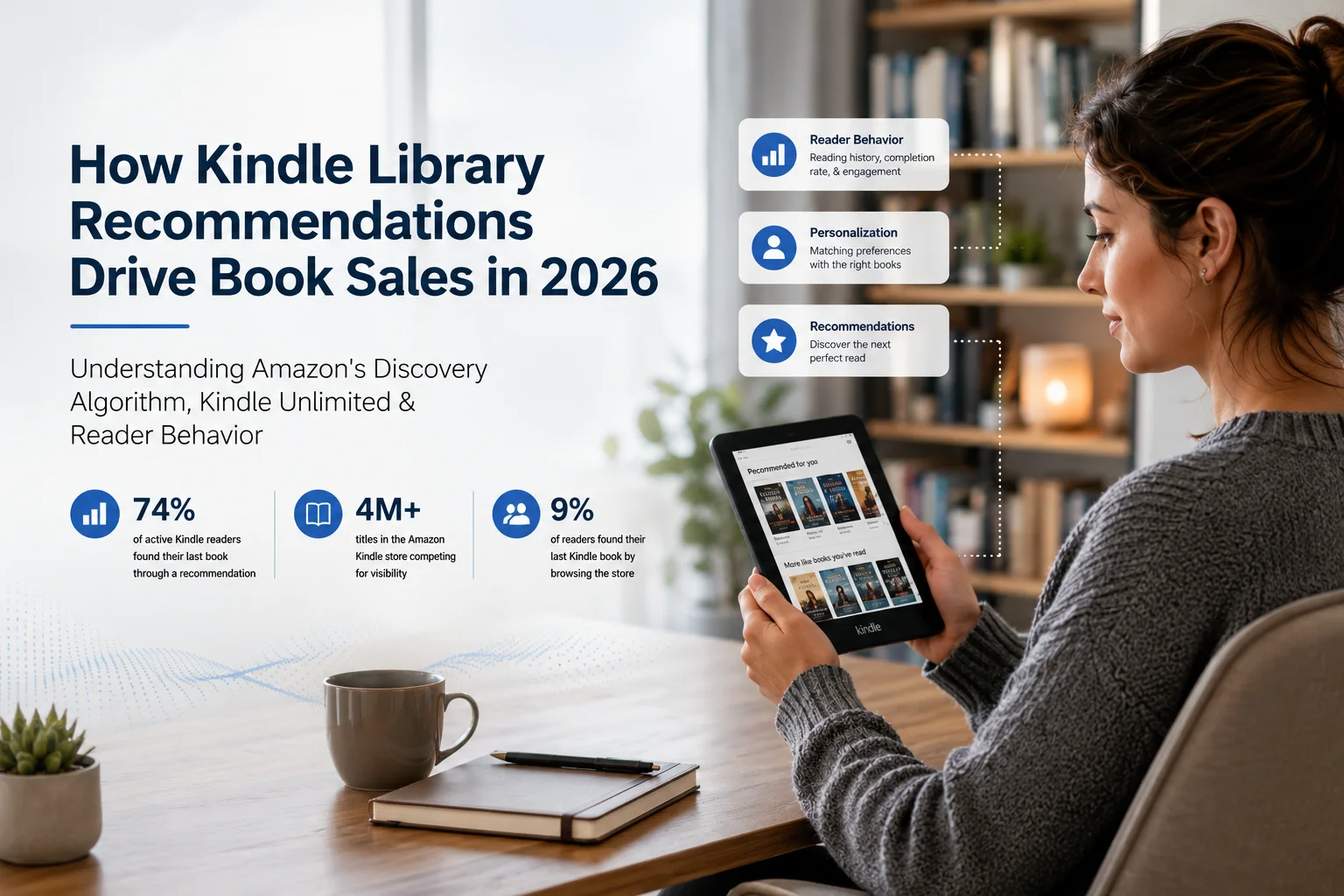
A reader in Phoenix opens her Kindle app on a Tuesday evening. She finishes the thriller she started over the weekend, taps "store," and within thirty seconds she has downloaded the next one. She didn't search for it by title. She didn't type an author's name. Amazon placed it in her recommended list based on what she read last week, how far she got through it, what other readers with her reading history bought next, and which books in the thriller category have accumulated enough sales velocity and review weight for the algorithm to treat them as reliable recommendations. Her Kindle library — the collection of titles Amazon has assembled around her reading behavior — made the decision before she knew she was making one.
This is how most Kindle books get discovered in 2026. Not through author social media posts. Not through a Google search. Not through a bookstore display. Through the Amazon recommendation engine operating inside an active reader's Kindle library, matching her stated and inferred preferences against the catalog of available books and surfacing the titles that fit.
For authors, understanding how that engine works — what it looks for, what signals it rewards, what gets a book into a reader's recommended list versus what keeps it invisible — is the most direct path to building the kind of sustained discoverability that produces consistent sales. This guide covers the full picture.
|
74% of active Kindle readers found their last book through a recommendation, not a search |
4M+ titles in the Amazon Kindle store competing for recommendation placement right now |
9% of readers found their last Kindle book by browsing the store directly — the rest came through recommendations |
What the Kindle Library Actually Is
When Kindle users talk about their "Kindle library," they typically mean two things simultaneously. The first is the personal collection: every Amazon Kindle book they've ever purchased, downloaded for free, or borrowed through Kindle Unlimited, stored in their account and accessible on any device where they're signed in. This collection is the reader's private reading history made visible — a shelf that grows with every book they add and never shrinks unless they manually remove a title.
The second meaning is the discovery layer Amazon builds on top of that collection. The "Recommended for you" rows. The "Customers who bought this also bought" placements. The "More books like X" suggestions that appear after a reader finishes a title. This discovery layer is not the reader's library in the ownership sense. It's Amazon's recommendation engine using the reader's library as its primary input signal — inferring from what the reader has read, rated, and returned what they're likely to want next.
Both meanings matter to authors. The first matters because Kindle Unlimited readers who add a book to their library and don't read it still keep it accessible — which means a book downloaded but unread hasn't generated KENP earnings yet but hasn't been lost either. The second matters far more, because the discovery layer is where new books enter a reader's world, and getting into that layer is what determines whether a book sells beyond the author's existing audience.
How Amazon's Recommendation Engine Decides What to Show
Amazon has never published a complete technical description of how its recommendation algorithm works. What's known comes from Amazon's own patents (which describe the collaborative filtering system in general terms), from observed behavior across millions of author and reader interactions, and from research published by data analysts studying the platform. The picture that emerges is consistent enough to act on.
The system operates on two types of signals: explicit and implicit. Explicit signals are things readers do deliberately: they rate a book, they add it to a wishlist, they write a review, they click "not interested" on a recommendation. Implicit signals are things readers do without thinking about it: how fast they read a book (reading pace inferred from page-turn frequency), how far they get before stopping, whether they immediately start another book by the same author after finishing one, whether they return a Kindle book for a refund within the return window.
For authors, the implicit signals are the ones that matter most, because readers generate them constantly without realizing it and because they're harder to game than explicit signals. A book that gets strong explicit signals (many positive reviews) but weak implicit signals (low completion rate, many early exits) will not sustain recommendation placement. Amazon's algorithm is in the end measuring whether readers who start a book find it worth finishing, and it weights that behavioral evidence heavily over static review counts.
The practical implication: a book that hooks its genre readers in the first chapter and sustains that engagement through to completion generates better implicit signals than a book that starts slowly, even if both books have identical review counts. Genre readers know within the first few pages whether a book is delivering the experience they came for. The algorithm knows it too, because it can see the reading behavior.
The Four Discovery Pathways Inside the Kindle Store
Amazon surfaces kindle books to readers through four primary discovery pathways. Understanding each one separately is useful, because the actions that improve visibility in one pathway are not always the same as the actions that improve visibility in another.
Search-based discovery happens when a reader types a query into the Kindle store search bar. "Best psychological thrillers." "Romance books similar to Colleen Hoover." "Mystery series to read in order." Amazon's search results for these queries are determined primarily by keyword relevance (how well the book's metadata matches the query), sales velocity in the relevant category, and review count. A book with strong keyword placement in all seven KDP keyword fields, correct category assignment, and twenty-five or more reviews will rank meaningfully higher in genre search results than a book with identical content but weak metadata.
Category browsing happens when a reader navigates through the Kindle store by category rather than by search. They tap "thrillers," then "psychological thrillers," then sort by "best sellers" or "new releases." The books that appear at the top of these browsing views are determined by their Best Seller Rank within that specific subcategory. BSR is updated hourly and reflects recent sales velocity. A book that was a category bestseller six months ago but hasn't been promoted since will have drifted down the list and become invisible to category browsers.
Also-bought and "more like this" recommendations appear on a book's own product page and on the product pages of books a reader is currently viewing. These recommendations are the algorithmic connections Amazon has built between titles based on the purchasing and reading behavior of thousands of readers who bought or read both books. Getting into the also-bought row of a bestselling title in your genre is one of the most valuable discovery positions available, because it places your book in front of readers who have already demonstrated exactly the genre preference your book satisfies. These connections are built by Amazon automatically over time as purchase overlap accumulates — they can't be directly requested, but they develop faster when your book is being read by genre readers who are also reading the bestsellers in your category.
Personalized homepage recommendations are the "Recommended for you" rows that appear when a signed-in reader opens the Kindle app or the Amazon homepage. These are generated by the collaborative filtering system matching the reader's personal history against books that readers with similar histories have enjoyed. Getting into a reader's personalized recommendations requires that the algorithm has seen enough readers similar to that reader purchase or engage positively with your book. This is the hardest discovery pathway to directly influence — it's built by accumulating the right kind of reader signals across time, not by any single action. But it's also the highest-value placement, because it reaches readers who weren't looking for your book at all and presents it as a personalized match.
What Kindle Unlimited Books Get That Paid Books Don't
A reader who subscribes to Kindle Unlimited and opens their Kindle library sees their experience differently from a reader who buys books individually. Their library contains both purchased books and borrowed Kindle Unlimited titles. When they browse the "Recommended" section of the Kindle store, Amazon displays a badge on KU-enrolled titles that reads "Included with Kindle Unlimited" — and this badge functions as a conversion accelerator.
A KU subscriber browsing the store faces a different decision for a KU title than for a paid title. For a paid book, they're deciding whether to spend $4.99 or $7.99 or $12.99. For a KU book, they're deciding whether to use one of their library borrows on it. The friction of the decision is dramatically lower. The "Read for Free" button requires no financial commitment beyond the subscription they've already paid. Readers who are on the fence about a title will borrow it far more readily than they'll buy it.
This means KU enrollment changes how a book appears inside a KU subscriber's Kindle library browsing experience, and it changes it favorably. The books in the store that carry the KU badge are essentially pre-qualified as low-friction picks for the subscriber. Genres with high KU subscriber density — romance, thriller, cozy mystery, fantasy, science fiction — see meaningful conversion rate advantages for enrolled titles over non-enrolled titles when the browsing audience is primarily KU subscribers.
The implication for authors deciding between KDP Select enrollment and wide distribution: if your genre has strong KU readership and your primary discovery channel is inside the Amazon Kindle store, the KU badge is a conversion tool you're leaving unused by staying wide. The badge appears in the reader's Kindle library view, in search results, in also-bought rows, and in personalized recommendations. Every time a KU subscriber sees your book anywhere in Amazon's discovery system, that badge does conversion work the book's description and reviews don't have to do alone.
Reviews, Ratings, and Reader Behavior: What Actually Signals Quality to the Algorithm
Ask most authors what they need to improve their Kindle book's discoverability and they'll say "more reviews." This is correct but incomplete. The algorithm doesn't just count reviews. It reads the pattern of reviews: the distribution of star ratings, how fast reviews arrive after publication, and how review sentiment correlates with reading behavior.
A book that launched six months ago and accumulated 30 reviews in its first two weeks and then stopped receiving reviews looks different to the algorithm than a book that has been accumulating reviews steadily across six months. The second book is actively being read by new readers. The algorithm treats it as a live title with ongoing reader engagement rather than a title that had a brief launch event and then went quiet.
This is one of the most underappreciated arguments for ongoing backlist promotion. A book with 45 reviews that receives 5 new reviews in a month — because the author ran a targeted promotional push that reached new genre readers — signals to Amazon's algorithm that the title is still being actively read and is generating new reader responses. That signal refreshes the book's recommendation eligibility in ways that passive accumulation over time doesn't. According to research published by Kindlepreneur tracking KDP title performance, review velocity in the trailing 30 days is a stronger positive signal for algorithmic recommendation placement than total review count. A book with 20 recent reviews outperforms a book with 100 old reviews on this metric.
Star rating distribution matters too. A book with 45 reviews averaging 4.2 stars converts browsers better than a book with 45 reviews averaging 3.8 stars — not only because readers prefer higher-rated books, but because Amazon's algorithm factors average rating into recommendation scoring. The difference between 3.8 and 4.2 sounds small. In a genre category with thousands of competing titles, it's a meaningful ranking signal.
Metadata: The Invisible Infrastructure That Determines Search Visibility
Every Kindle book in the Amazon store has a metadata profile: title, subtitle, description, seven keyword fields, two browse category assignments, and BISAC subject codes. This metadata is the primary input Amazon's search algorithm uses to determine which queries a book should appear in. It's the most direct lever authors have over their own discoverability inside the Kindle store.
Most indie authors fill in this metadata once at publication and never revisit it. This is a significant missed opportunity, for two reasons. First, reader search behavior changes over time. The queries that readers type into the Kindle store in 2026 are not identical to the queries they typed in 2022. Genre trends shift. New subgenres emerge. Specific author names or comparable titles become popular search terms as those authors grow. A book's keyword fields should be reviewed and updated at least twice a year to reflect current reader search behavior.
Second, category placement determines which bestseller lists a book competes on. Amazon allows authors to select two browse categories at publication, but additional category placement can be requested through KDP customer service by naming specific categories and asking to be added. A book in three or four relevant categories has three or four separate bestseller lists on which it can achieve "bestseller" badge status, each of which is visible to readers browsing that category. A book in one generic category competes on one crowded list where the chance of badge status is lower.
The keyword fields are the highest-use piece of metadata for search visibility. Seven fields, each allowing up to 50 characters. The correct approach is to fill each field with a specific multi-word phrase — not a single keyword — that matches the exact language a reader in your genre would type into the search bar when looking for a book like yours. "Psychological thriller female protagonist," not "thriller." "Small town cozy mystery series," not "mystery." The specificity of the phrase determines the relevance of the match, and relevance is what gets a book into the search results a genre reader is actually looking at.
How Readers Actually Use Their Kindle Library Day to Day
Understanding how readers interact with their Kindle library: not how the algorithm works, but what readers actually do when they open the app. gives authors a different and equally useful perspective on discoverability.
Most active Kindle readers maintain what they describe informally as a "to-read queue": a list of books in their library that they've downloaded or purchased but haven't started yet. This queue is both an opportunity and a problem for authors. The opportunity: a book that gets into a reader's library through a free day promotion, a Kindle Unlimited borrow, or a sale price download is now inside the reader's daily reading interface. Every time they open the app, that book is visible on their shelf. It doesn't need to re-compete for discovery — it's already in the most important place, which is the reader's own collection.
The problem: a reader with 40 unread books in their to-read queue treats new additions differently from a reader with 5. A reader with a small queue reads what they download promptly. A reader with a large queue downloads promiscuously and reads selectively — and what they select to read next from a large queue is determined by mood, by what they remember most vividly from when they downloaded it, and by the cover and opening pages when they scroll their library. This is why cover quality and the strength of a book's opening chapter are not just marketing decisions — they're re-engagement decisions that happen inside the reader's own library every time they're looking for their next read.
Active Kindle readers open the app an average of six times per week, according to data published by Written Word Media. Each session is a moment when a book in that reader's library either gets chosen or passed over. The books that get chosen are the ones whose covers communicate immediately what reading experience they deliver, whose opening lines deliver on that promise, and whose position in the library queue is recent enough to feel like an active intention rather than a forgotten download.
Free Kindle Books: What They Do and Don't Do for Discovery
The free kindle books section of the Amazon store: books available at no cost through KDP free days, permanent free pricing, or Kindle Unlimited availability. is one of the highest-traffic areas of the Kindle store. Readers who browse free kindle books are actively looking for something to add to their library, and the friction of the decision is at its absolute minimum. No price to evaluate. Just: does this look like a book I want to read?
For authors, getting a book into the hands of readers through free distribution creates a library presence that a paid book sale also creates, but at a higher volume and lower cost per reader acquired. A reader who downloaded your thriller for free during a KDP free day now has it in their Kindle library. If they read it, you've earned a potential reviewer, a potential buyer of your next book, and a potential recommender to other readers in their network. The free acquisition is the start of a reader relationship, not the end of one.
What free distribution doesn't do: it doesn't directly generate revenue, and it doesn't generate KENP earnings (free downloads don't count as pages read in Kindle Unlimited). It doesn't guarantee the book gets read — readers who download free books promiscuously often have library queues measured in hundreds of titles, most of which they'll never open. And it doesn't substitute for promotion: a book on a KDP free day with no external promotion will receive a fraction of the downloads that the same book would receive with a coordinated email blast to genre readers simultaneously.
The authors who use free kindle books most effectively treat the free period as a reader acquisition event rather than a revenue event. The goal isn't to give away as many copies as possible to anyone who'll take them. It's to get the book into the Kindle libraries of readers who are specifically interested in that genre and likely to actually read it. That specificity is what free day promotion services are designed to provide: not maximum volume, but maximum genre relevance. KindleBookHub's free day promotion reaches genre-segmented readers — thriller readers for thrillers, romance readers for romance — rather than blasting to a general free-book-hunting audience with no genre filter.
The Kindle Store vs. Other Retail Platforms: Where Readers Are
The amazon kindle store accounts for approximately 67% of all ebook sales in the United States, according to publishing industry data tracked by the Alliance of Independent Authors. Apple Books accounts for roughly 15%. Kobo accounts for approximately 10%. Google Play and other platforms split the remaining 8%.
These numbers vary significantly by genre and by reader demographics. Literary fiction readers are overrepresented on Apple Books relative to genre fiction readers. International readers — particularly in the UK, Canada, and Australia — buy a higher proportion of ebooks through Kobo than US readers do. Non-fiction readers in professional categories (business, personal development) are more evenly distributed across platforms than romance or thriller readers, who are concentrated on Amazon.
For most indie authors publishing genre fiction for a US audience, Amazon's Kindle store is where the majority of their potential readers are. This concentration has a practical consequence: the discoverability systems of the Amazon Kindle store: the recommendation engine, bestseller lists, also-bought rows, and personalized library suggestions. These matter more to their book's commercial prospects than the discoverability systems of any other platform. Investing in understanding and working with Amazon's recommendation engine is not a platform loyalty decision. It's a market-share acknowledgment.
This doesn't mean ignoring other platforms permanently. Authors who build a substantial reader base on Amazon and then distribute to Kobo and Apple Books often find that their Amazon credibility translates — readers who found them on Amazon search for them on other platforms, and their review count and category positioning arrive with them. Wide distribution becomes more valuable after Amazon visibility has been established than before it, because the author's discoverability infrastructure is already built on the platform where the most readers are.
Practical Steps: Getting Your Book Into Readers' Kindle Libraries
The following sequence is what the evidence from author communities, reader behavior data, and Amazon platform mechanics consistently points toward. It's not theory. It's the observable pattern of how kindle books move from invisible to discovered.
Step one — get the metadata right before promoting. Your book's seven keyword fields, two category placements, and description opening paragraph are the infrastructure that determines whether any promotional traffic converts into sales. Keyword fields should contain specific multi-word phrases matching real reader search behavior in your genre. Category placement should put you in the most specific subcategory where you can realistically compete — "Kindle Store > Kindle eBooks > Mystery, Thriller & Suspense > Thrillers & Suspense > Psychological" is more useful than "Kindle Store > Kindle eBooks > Fiction" for a psychological thriller. Review your metadata against the top-ranking books in your target subcategory and align your keyword language with theirs.
Step two — build the review foundation before driving volume. Fifteen or more reviews on launch day, acquired through an ARC campaign run three to four weeks in advance, is the threshold where promotional traffic converts at a meaningful rate. Below ten reviews, browsers who arrive through promotion see a book with almost no social proof. Their conversion rate is low. The promotional spend produces fewer sales than it should. KindleBookHub's ARC and review campaign service connects authors with genre-verified readers in their specific category who have a documented history of completing books and posting honest reviews.
Step three — drive coordinated launch-week volume. The first week of a book's sale history is when Amazon's algorithm weights velocity signals most heavily. A book that sells 400 copies in its first seven days tells the algorithm something fundamentally different from a book that sells 400 copies over its first sixty days. Coordinating an email blast to genre readers simultaneously with social promotion during launch week produces the concentrated velocity that triggers algorithmic attention. A single promotion channel running alone rarely produces the spike necessary. Two or three channels running simultaneously do.
Step four — maintain review velocity through backlist promotion. Once the launch window closes, the books that stay visible in the Kindle library recommendation system are the ones still generating new reader engagement. A quarterly promotional push: a Kindle Countdown Deal timed to a targeted email blast, a social push through a genre reader community. generates the review velocity and sales activity that keeps the algorithm treating the book as an active title rather than a declining one. KindleBookHub's promotion packages are designed specifically for both launch promotion and ongoing backlist maintenance, with genre-matched email and social reach that keeps your book in front of the right readers consistently rather than in isolated bursts.
Get Your Book Into the Right Readers' Kindle Libraries
KindleBookHub reaches 200,000+ genre readers across email and social — thriller readers for thrillers, romance readers for romance. Genre-matched promotion that drives downloads from readers who actually finish books, leave reviews, and come back for your next title.
Why Most Kindle Books Stay Invisible: The Specific Gaps
The distance between a book that lives permanently in the Kindle store's recommendation system and a book that sells 80 copies and disappears is not primarily a quality gap. It's a systems gap. The books that stay invisible share specific characteristics, and those characteristics are fixable.
Their metadata uses generic single-word keywords rather than specific multi-word phrases matching actual reader search behavior. Their category placement is in a top-level category with hundreds of thousands of competing titles rather than a specific subcategory where they could rank. Their review count never reached the threshold where Amazon's algorithm has enough signal to recommend the book confidently. Their launch had no coordinated promotion — the author posted about it on social media, received support from their existing followers, and sold 60 copies in the first week, which told the algorithm nothing interesting. Their description summarizes the plot rather than promising the genre experience.
Every one of these gaps is specific and correctable. The metadata can be rewritten today. The category placement can be changed through KDP's category request process. The review count can be built through a targeted ARC campaign before the next promotional push. The launch coordination can be planned for the next book. The description can be rewritten using the emotional promise framework rather than the plot summary framework.
The books that reach readers' Kindle libraries and stay there didn't arrive by accident. They arrived because someone made a series of specific, documented decisions about metadata, review building, launch coordination, and ongoing visibility maintenance. Those decisions are learnable and repeatable. The Kindle store's discovery system rewards them consistently, across genres, across publishing formats, and across career stages. The first time an author runs a coordinated launch with a review foundation, a targeted email blast, and genre-aligned metadata, the sales numbers look different from every uncoordinated launch that came before it. The algorithm noticed. It was waiting for the signal the whole time.
Frequently Asked Questions
What is a Kindle library and how does it work?
A Kindle library is the collection of all books associated with an Amazon account — purchased Kindle books, Kindle Unlimited borrows, and titles downloaded during KDP free days. It's accessible through the Kindle app on any device where the reader is signed in, and it syncs automatically across devices. Amazon also uses a reader's library activity — what they've read, how far they got, what they borrowed — as input data for its recommendation engine, which surfaces new books based on that reading history.
How does Amazon decide which Kindle books to recommend to readers?
Amazon's recommendation engine uses a combination of explicit signals (star ratings, reviews, wishlist additions) and implicit behavioral signals (reading pace, completion rate, whether a reader immediately starts another book by the same author). The system matches a reader's history against books that readers with similar histories have enjoyed. For authors, the most actionable signals are review count, review velocity (how recently new reviews are arriving), keyword metadata relevance to genre searches, and the book's reading completion rate inferred from Kindle device data.
Do free Kindle books hurt an author's income or reputation?
No, when used strategically. Free Kindle books — through KDP free days or permanent free pricing on a series starter — are a reader acquisition tool, not a revenue tool. The goal is to get the book into the Kindle libraries of genre-qualified readers who are likely to read it, review it, and buy subsequent books. The damage comes when free promotion is used without targeting: giving away thousands of copies to general free-book hunters who never read what they download generates poor completion rates and poor implicit signals to Amazon's recommendation algorithm. Genre-targeted free promotion is the correct approach.
How many reviews does a Kindle book need before Amazon recommends it?
Amazon doesn't publish a specific threshold, but observed platform behavior consistently shows that books crossing 25 reviews see a measurable increase in organic also-bought and "more like this" placement. Below 10 reviews, the algorithm has insufficient signal to recommend a book confidently. The most effective approach is to arrive at launch with 15 or more reviews already posted through an ARC campaign, then sustain review accumulation through ongoing targeted promotion rather than treating the review count as a launch-and-forget metric.
Does Kindle Unlimited enrollment affect how a book appears in a reader's Kindle library?
Yes. Kindle Unlimited books display a "Included with Kindle Unlimited" badge in the Kindle store and in recommendation placements, which functions as a conversion accelerator for KU subscribers by removing the purchase barrier. KU subscribers can borrow the book immediately without a separate purchase decision. In the reader's Kindle library, borrowed KU titles appear alongside purchased books. For genres with high KU readership — romance, thriller, cozy mystery, fantasy — the KU badge is a meaningful conversion advantage in recommendation placements.
The Bottom Line
The Kindle library is where readers live. It's where they spend their reading time, make their next-book decisions, and receive Amazon's recommendations about what to read after they finish the book they're on. Getting a book into that environment, into a genre reader's actual library, is the primary goal of every promotion decision an author makes.
The path there is specific. Right metadata so Amazon knows which searches to surface the book in. Enough reviews for the algorithm to trust the book as a recommendation. Coordinated launch-week promotion that produces the velocity spike that gets the algorithm's attention in the first place. Ongoing quarterly maintenance that keeps the book visible as an active title rather than a declining one.
None of this is passive. The Kindle store has four million titles. The recommendation engine has to decide, for every reader, every time they open the app, which books to show and which to leave invisible. The books it shows are the books that have given it reasons to show them. The books it leaves invisible are the books that haven't.
Give the algorithm a reason. It's looking for one.
Related reading: How to Promote Your Kindle Book and Actually Get Sales: The 2026 Guide
Related reading: KDP Select in 2026: Is It Worth It for Indie Authors?