

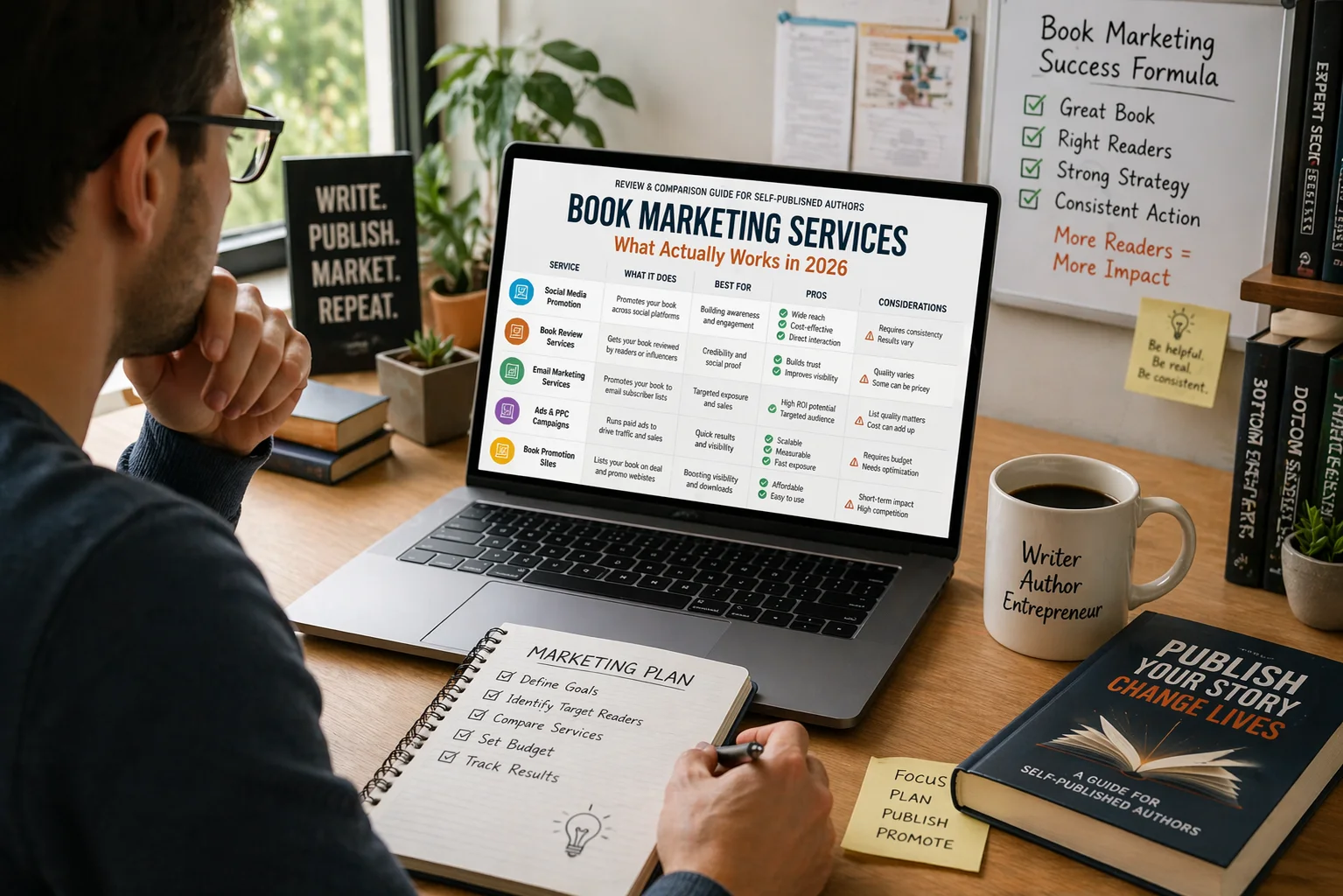
Publishing a book on Amazon is no longer the hard part. Over 7,500 new books are uploaded to the Kindle store every single day. The hard part is getting your book seen by the right reader at the right moment, without burning through your budget on services that sound impressive and deliver nothing you can measure.
This guide covers what book marketing services for self-published authors actually do, what separates the ones that work from the ones that do not, and what you need to have in place before any campaign has a chance of succeeding.
If you have a Kindle book sitting on Amazon with a handful of reviews and steady but slow sales, this is the page you should be reading.
What Book Marketing Services for Self-Published Authors Actually Do
A book marketing service gets your title in front of people who are not currently looking at your Amazon page. That is the entire job.
The mechanism varies: some services send your book to an email newsletter of readers who have opted in to hear about new Kindle titles. Others place your book on a featured homepage listing where book buyers browse. Some post about your book across social media channels daily. The best services combine more than one of these approaches so your title gets multiple exposures across different touchpoints.
What no marketing service can do is replace a weak book page, manufacture reviews that do not exist, or guarantee a specific sales number. Any service that promises those outcomes is either misleading you or working in ways that violate Amazon's terms of service.
The difference between promotion that works and promotion that does not comes down to one thing: the quality and intent of the audience being reached. A newsletter with 20,000 readers who subscribed specifically to find new Kindle books in your genre will outperform a social media account with 500,000 general followers every time. Intent beats size.
The Problem Most Self-Published Authors Run Into
Most indie authors think about book marketing as something they do once, right after publishing. They put the book live, run one campaign, watch the spike, and then watch it flatline.
The authors who build real traction think about marketing differently. They treat it as a system that runs continuously, with different tactics doing different jobs at different points in the book's life.
Launch week is important. But Amazon's algorithm does not care about a single spike. It responds to consistent, sustained sales velocity over time. A book that sells 10 copies a week for 6 months is treated very differently by Amazon's recommendation engine than a book that sells 60 copies in its first week and nothing after.
This is why promotion services that offer multi-week or month-long campaigns produce stronger lasting results than one-day placements. The exposure compounds over time rather than peaking and dropping.
Research by Kindlepreneur — one of the most cited resources in indie publishing — consistently shows that authors who treat marketing as a long-term system, rather than a launch event, see significantly better lifetime earnings per title.
Five Things to Look for Before You Pay for Any Book Marketing Service
1. A clear, verifiable subscriber count
Good services tell you exactly how many opted-in email subscribers they have. Not "millions of readers" or "massive reach." A specific number, broken down by genre where possible. If a platform will not give you this information, that is your answer.
2. A manual review process for submitted books
Platforms that publish every submission without review have trained their audience to trust them less over time. Readers who have found poorly formatted, mislabeled, or low-quality books on a site stop paying attention to that site's picks. The review process protects the reader's trust, which is exactly what makes the promotion valuable to you.
3. Genre matching
Your book in a newsletter full of readers who prefer a different genre will underperform regardless of how good the campaign is. Ask whether the platform segments by genre or at minimum whether their audience is concentrated in your category. Romance, thriller, mystery, science fiction and fantasy, and self-help tend to see the strongest results with email-based Kindle promotion.
4. Transparent pricing with specific deliverables
You should know before committing what you are buying: how long the campaign runs, which channels are included, and whether newsletter placement is part of the package or an add-on. Vague package names and generic outcome promises are red flags.
5. A real operating history
A platform that has been running for years has tested what works, built a reader audience that trusts its curation, and accumulated enough data to know which genres perform best in which campaign formats. A platform that launched recently is still figuring those things out at your expense.
What You Must Have in Place Before Any Campaign Starts
This is the section most guides skip. If your book page has these problems, no marketing service in the world will perform well for you.
Your cover must match your genre
Readers on Kindle decide whether to click in under three seconds. Your cover's first job is to signal genre immediately. If your thriller cover looks like a literary fiction title, romance readers will skip it and thriller readers will not recognize it. If your cover looks self-made, it signals to readers that the book may also be unpolished.
A professional, genre-appropriate cover is the highest-ROI investment a self-published author can make. The Alliance of Independent Authors rates cover design as the single most impactful factor in book discoverability, ahead of metadata, pricing, and advertising.
Your book description needs to convert, not summarize
Your Amazon description is a sales page, not a plot summary. It should create curiosity, establish stakes, and give the reader a reason to click Buy Now rather than a Wikipedia-style recap of the story. Authors who rewrite their descriptions to be more conversion-focused consistently report higher click-to-purchase ratios from promotional traffic.
Your Amazon keywords and categories need to be correct
Amazon KDP gives you 7 keyword slots. Most authors use them poorly. Your keywords should reflect how readers actually search for books in your genre, including trope phrases, mood descriptors, and comparison author names. The categories you select determine which bestseller lists you are eligible for and where Amazon surfaces your book in search results.
Kindlepreneur's Publisher Rocket tool is one of the most practical resources available for identifying the right keywords and categories for your specific book.
You need reviews before you run a campaign
Sending promotional traffic to a book page with zero reviews produces poor results. Readers treat review count as a trust signal. A book with 15 reviews at 4.2 stars converts significantly better from promotional traffic than the same book with no reviews. If you do not have reviews yet, focus on that first. Reach out to your existing network, use ARC reader platforms, or submit to reader communities in your genre.
Types of Book Marketing Services and When to Use Each
Email newsletter promotions
Best for: launching a new title, running a KDP price promotion or Kindle Countdown Deal, or refreshing a backlist title.
How they work: your book appears in a newsletter sent to an opted-in list of readers who subscribe to hear about new Kindle books. This drives the fastest, most measurable short-term results.
What to look for: genre-specific or genre-relevant subscriber base, clear subscriber count, direct Amazon link included in the placement.
Featured website placement
Best for: sustained visibility over weeks or months, building familiarity with an audience that needs multiple touchpoints before buying.
How they work: your book appears on a curated book platform where readers browse new titles. Unlike a newsletter campaign that peaks and fades, a listing stays visible as long as the placement is active.
What to look for: clean, credible-looking platform, active visitor traffic, book pages that display well on mobile.
Social media promotion
Best for: ongoing discovery, keeping your title visible between other campaign types, building the kind of repeated exposure that drives eventual conversions.
How they work: daily posts about your book across platforms where book buyers are active. Readers rarely buy a book they have seen once. They buy books they have seen four or five times.
What to look for: consistent posting schedule, relevant platform selection for your genre, posts that present your book naturally rather than as obvious paid advertising.
Full-service book marketing agencies
Best for: authors with larger budgets, series with multiple titles, authors building a long-term author brand rather than promoting a single book.
What to look for: transparent pricing, specific campaign deliverables, named team members with publishing industry backgrounds, verifiable client results.
At KindleBookHub, our three promotion plans — Basic, Standard, and Premium — cover email newsletter campaigns, featured placement, and daily social promotion at pricing designed for independent authors. You can review our promotion plans and see exactly what each one includes before committing anything.
What Results to Realistically Expect
Honest book promotion services talk about visibility, not guaranteed sales. Here is what you can reasonably expect from a well-run email newsletter campaign.
In the 48 to 72 hours following a newsletter send, you will typically see an increase in page views on your Amazon listing, a rise in Kindle Unlimited page reads if your book is enrolled in KDP Select, and some conversion to paid sales, the volume of which depends heavily on your book page quality and genre fit with the newsletter audience.
The longer-term result of a sustained campaign is accumulated reviews, which outlast the campaign itself. Readers who find your book through a promotion and enjoy it are the most likely source of new organic reviews. Those reviews stay on your page permanently and influence every future reader who lands there.
Authors who see the strongest long-term results from promotion are those who build it into a repeating system rather than treating it as a launch day event. Email promotion during a KDP price window, followed by ongoing featured placement, followed by a newsletter refresh a few months later — this kind of planned sequence builds real and lasting visibility on Amazon.
A Note on Backlist Promotion
One of the most overlooked opportunities in indie publishing is the backlist. A book published two years ago with solid reviews and a strong cover has not stopped being relevant to the readers who have not discovered it yet.
From a promotion standpoint, a backlist title is often a stronger candidate for a newsletter campaign than a brand new release, because it already has social proof in the form of reviews, it is already priced appropriately, and the author no longer has the pressure of launch week expectations distorting their view of results.
If you have published more than one book, promoting your backlist consistently is one of the most underused strategies available to you. You do not need to wait for a new release to benefit from promotion.
Frequently Asked Questions About Book Marketing Services for Self-Published Authors
What are book marketing services for self-published authors?
Book marketing services for self-published authors are platforms, agencies, or individuals that help your book reach readers you would not find on your own. These include email newsletter campaigns, social media promotion, book listing placement, Amazon ad management, and publicity services. The best services have an existing audience of opted-in readers looking for new books in your genre.
How much do book marketing services cost?
Costs vary widely depending on the service type. Email newsletter placements on dedicated book promotion sites typically range from $50 to $300 per campaign. Full-service marketing agencies charge anywhere from $1,000 to $10,000+ per month. For most indie authors, starting with a focused newsletter campaign on a platform like KindleBookHub ($50 to $241) is more practical and measurable than a broad agency retainer.
Do book marketing services actually work for self-published authors?
Yes, when the service matches your genre, your book page is already optimized, and you have a realistic expectation of what promotion does. A campaign drives visibility. What converts that visibility into sales depends on your cover, description, pricing, and how well your book fits the audience being reached. Authors who see the best results treat promotion as part of a system, not a one-time fix.
When is the best time to use a book marketing service?
Three situations produce the strongest results: during a planned book launch when you need maximum visibility in the first 30 days, when running a KDP price promotion or Kindle Countdown Deal and you want readers to know about it, and when promoting a backlist title that has not been marketed since its original release. All three require a solid Amazon book page before the campaign begins.
What should I prepare before using a book marketing service?
Your Amazon book page needs to be ready. That means a professional genre-appropriate cover, a description written to convert browsers into buyers, correct keywords and categories in your KDP dashboard, and at least a few honest reviews already on the page. Sending promotional traffic to a page missing any of these will underperform regardless of the promotion quality.
Can I promote a Kindle book that is already published?
Yes. Many indie authors under-promote their backlist. A book that sold reasonably at launch and then went quiet can be brought in front of new readers through a newsletter campaign or featured placement. Backlist promotion often produces stronger ROI than launch campaigns because the book already has reviews and a track record.
How is a book promotion service different from Amazon Ads?
Amazon Ads show your book to people already searching on Amazon. Book promotion services reach readers through email newsletters and social media, where your book reaches people who are not currently on Amazon but are actively looking for new titles to read. The two approaches complement each other rather than competing.
How long does it take to see results from book marketing?
Email newsletter campaigns drive the fastest results, with most activity in the 48 to 72 hours after the campaign goes live. Social media and ongoing placement build more gradually. Organic results from review accumulation take weeks to months. Most successful indie authors treat marketing as a continuous system rather than a one-time event.
Summary: What to Do Next
If you are a self-published author who has been watching your Amazon sales stay flat and wondering whether book marketing services are worth the investment, the answer depends entirely on preparation.
Before you spend a dollar on promotion, check your cover, your description, your keywords, and your review count. Fix anything that is clearly not working. Then select a promotion service that can tell you specifically who their audience is, how many subscribers they have, and what your campaign will include.
KindleBookHub has been running Kindle book promotion campaigns for independent authors since 2011. Our reader network is U.S.-focused and opted-in. Every book is reviewed before it goes live on the platform. If you are ready to move forward, browse our promotion plans or contact our team to talk through which approach fits your book and your goals.