

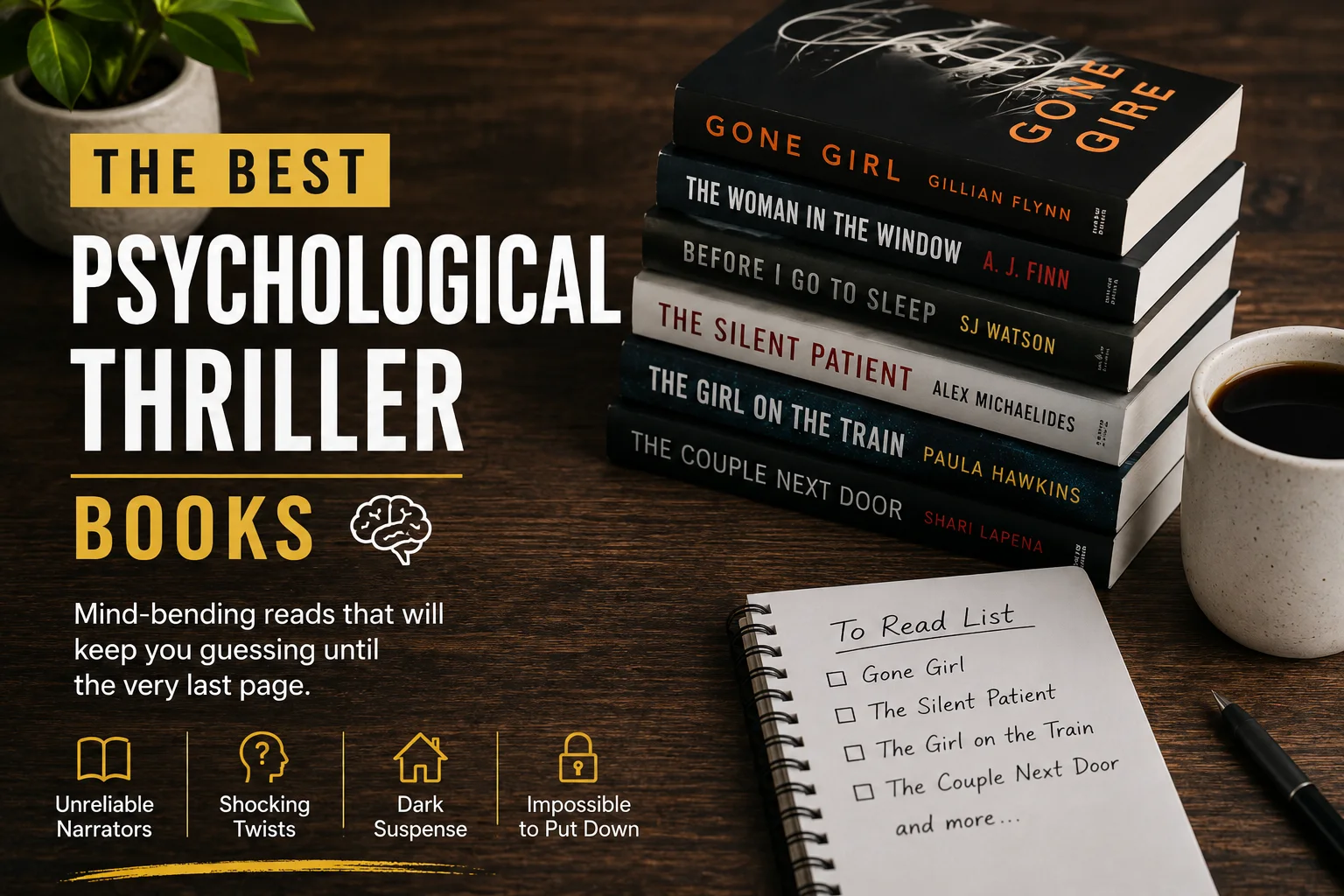
The best psychological thriller books don't just keep you up at night. They make you question what you thought was real for days afterward. You close the book and immediately flip back to chapter three because something in the final reveal changes everything you thought you understood about what happened on page 47.
That specific feeling — half dread, half delight, entirely unable to put it down — is what separates a great psychological thriller from a good one. This list is built around that feeling. Every book here earns it. Some of them will unsettle you. A few will genuinely disturb you. All of them will make the next two weeks of commutes, lunches, and late nights significantly better.
The list is organized by what you're in the mood for — because what you want from a psychological thriller changes. Some nights you want an unreliable narrator whose version of events unravels slowly. Other nights you want a plot twist that physically makes you put the book down and stare at the ceiling. We've sorted by that. Find your mood, start reading.
Unreliable Narrator — You Never Know What's Real
These are the psychological thriller books where the person telling the story turns out to be the least trustworthy person in it. The reader gets all the information through a narrator who is hiding something, misremembering, actively lying, or simply not mentally reliable. By the last chapter, you realize you've been reading a version of events that was shaped by someone with an agenda you only just understood.
1. Gone Girl — Gillian Flynn
On the morning of Nick and Amy Dunne's fifth anniversary, Amy disappears. What follows is narrated alternately by Nick — who is suspicious, evasive, and not grieving quite right — and by Amy through her diary entries. The genius of Gone Girl is that Flynn trusts the reader to be unsettled by both narrators simultaneously. You don't know who is lying. You're not entirely sure either of them is telling the truth. The final third is genuinely startling in a way that is earned by the setup rather than dropped in from nowhere. One of the best psychological thriller novels of the last 20 years and still the benchmark for the unreliable narrator format.
2. The Woman in the Window — A.J. Finn
Anna Fox is an agoraphobic psychologist who spends her days drinking wine, watching old films, and observing her neighbors through her window. One night she witnesses something she wasn't supposed to see. The problem: no one believes her. The book works because Finn makes Anna a genuinely sympathetic and genuinely unreliable narrator at the same time — you understand why people doubt her, and you doubt her yourself. The pacing is precise, the misdirection is fair, and the reveal lands. If you liked Gone Girl and haven't read this one, go immediately.
3. Behind Closed Doors — B.A. Paris
Jack and Grace Angel appear to be the perfect couple. Their house is perfect. Their marriage looks perfect. Paris builds the dread of this novel through the gap between how things look from outside and what Grace knows is happening inside. It's told in alternating timelines — the present and the past — and the horror of it is that the reader understands what's happening long before the other characters do. Claustrophobic in exactly the right way. Not a comfortable read. Impossible to put down.
4. Before I Go to Sleep — S.J. Watson
Christine wakes up every morning with no memory of her life. The man in her bed tells her he's her husband. The photos on the wall confirm it. But every morning she starts from zero, trusting only what she's told. Watson plays this setup with tremendous restraint — the horror of Christine's situation deepens slowly and the betrayal, when it arrives, is both surprising and in retrospect completely obvious. The psychological thriller premise here is as clean as it gets: what if you couldn't trust your own memory, and the person who filled in the gaps for you had a reason to lie?
5. The Silent Patient — Alex Michaelides
Alicia Berenson shot her husband five times in the face and hasn't spoken a word since. Theo Faber, a criminal psychotherapist, becomes obsessed with understanding why. This debut novel sold over a million copies in its first year and the reason is simple: Michaelides constructs a puzzle with real precision. Every piece the reader is given feels complete. The reveal in the final pages recontextualizes the entire novel in a way that is genuinely jaw-dropping and — crucially — does not feel cheap. One of the best psychological thrillers published in the last decade. Start on a weekend, because you will not stop.
6. Verity — Colleen Hoover
Struggling writer Lowen Ashby is hired to complete the remaining books in a bestselling series after the author, Verity Crawford, is incapacitated. While staying in the Crawford home, Lowen finds a manuscript — what appears to be Verity's autobiography — that contains confessions no one was ever meant to read. Hoover writes dark psychological suspense with the same emotional intensity she brings to her romance novels, and the combination is genuinely unsettling. The ending splits readers. That is its own kind of achievement. Disturbing in a way that lingers.
Shocking Twists — The Ending Changes Everything
The books in this section are built around a final revelation that reframes everything that came before it. The twist isn't a trick — it's the answer to a question the book has been asking from page one. The best ones make you want to immediately reread the first chapter with your new knowledge. They're all on this list because they earned it.
7. The Girl on the Train — Paula Hawkins
Rachel takes the same commuter train every day and watches the same houses pass her window. She becomes fixated on a couple who seem to have the perfect life she's lost. Then, one morning, she sees something that shatters that image. Then the woman disappears. Hawkins tells the story through three women with incomplete, competing, and unreliable accounts of the same events. The structure is the point: each narrator knows something the others don't, and the reader assembles the truth from the overlapping gaps. A genuine phenomenon for good reason.
8. I Am Pilgrim — Terry Hayes
A nameless American intelligence agent, known only as Pilgrim, is pulled out of retirement to investigate a threat that could kill millions. In parallel, a young Muslim man in Afghanistan has spent years perfecting a plan to destroy America. The two stories converge with a precision that is genuinely cinematic. At 700 pages, this should feel like a slog. It doesn't. It reads like a sprint. Hayes wrote this over a decade and it shows — the construction is meticulous. The best thriller debut in decades. The twist lands because it was built into the architecture from chapter one.
9. The Couple Next Door — Shari Lapena
Anne and Marco Conti left their baby sleeping in the house while they attended a dinner party next door. They checked on her every 30 minutes. When they came home at midnight, she was gone. Lapena's debut novel works because the suspects are all people with plausible, understandable motives, and the revelations arrive in layers — each one seeming to close the case and then opening a new one. The pacing is relentless. The final twist is legitimately shocking. This is comfort food for psychological thriller readers in the best possible sense.
10. Big Little Lies — Liane Moriarty
Told backward from a murder at a school trivia night to the events that led to it, Big Little Lies is simultaneously a sharply observed novel about friendship, motherhood, and domestic abuse, and a compulsively readable thriller. Moriarty tells you from page one that someone died at the trivia night. She withholds exactly who — and exactly what happened — for 400 pages, and the mystery of those two facts carries the entire book. The HBO adaptation is excellent. Read the book first.
11. The Kind Worth Killing — Peter Swanson
On a flight from London to Boston, Ted Severson tells a stranger he'd like to kill his wife. She offers to help. Swanson then proceeds to completely subvert every expectation that premise creates. This is a novel that delights in misdirection and pulls it off because the misdirection is honest — all the information is there, the reader just doesn't see it coming. The body count is higher than expected. The ending is perfect. One of the best psychological thriller novels in recent years that doesn't get the attention it deserves.
Domestic Suspense — Danger Inside the Home
These psychological thriller books are set inside relationships, marriages, and families where the threat isn't a stranger but the person you share a house with. The domestic thriller subgenre has produced some of the most psychologically precise books in the category because it operates in the space everyone recognizes — home — and makes it strange and threatening.
12. Disclaimer — Renee Knight
Documentary filmmaker Catherine Ravenscroft finds an anonymous novel on her bedside table — and realizes it tells a story she thought no one else knew. A story she's been hiding for twenty years. Knight builds the suspense through the gap between Catherine's outward composure and her inner terror, and through the slow revelation of what actually happened on a holiday in Italy decades earlier. The novel is told from two perspectives and the way those perspectives collide in the final act is genuinely brilliant. Underrated.
13. The Silent Wife — A.S.A. Harrison
Jodi and Todd have been together for twenty years. Their life looks stable from outside: the condo, the routine, the unspoken arrangements that long-term couples build around themselves. Harrison opens the novel by telling the reader exactly what is going to happen. Then she proceeds to explain, with tremendous psychological precision, exactly how they got there. This is a character study as much as a thriller — the horror comes from understanding both people too well. Published just before Harrison died, it became a word-of-mouth bestseller because readers couldn't stop pressing it on other people.
14. Then She Was Gone — Lisa Jewell
Ellie Mack disappeared at fifteen, ten years ago. Her mother Laurel has never recovered. Then Laurel meets a man in a coffee shop and falls into a new relationship — and discovers that his young daughter looks uncannily like the daughter she lost. Jewell's domestic thrillers are the best in the genre because she writes with genuine emotional depth rather than just plot mechanics. The reader cares about the characters, which makes the revelations hit harder than they would in a purely mechanical thriller. Read this one and then read all of Jewell's other books.
15. The Whisper Man — Alex North
A single father moves to a new town with his young son to rebuild after a family tragedy. In this same town, years earlier, a serial killer the police call The Whisper Man abducted and killed several young boys. Now children are going missing again. North weaves a grief novel and a thriller into a single piece in a way that shouldn't work and absolutely does. The relationship between the father and son is as emotionally real as anything in literary fiction. The thriller plot is as tight as anything in genre fiction. One of the best psychological thriller novels of the last five years.
Dark and Disturbing — Not for the Faint-Hearted
These books are further into the dark than most psychological thrillers go. They deal with violence, obsession, and the psychology of people who do terrible things, written with enough craft that reading them feels purposeful rather than gratuitous. They're not comfortable. They're not supposed to be. They're also unforgettable.
16. Sharp Objects — Gillian Flynn
Reporter Camille Preaker returns to her hometown in Missouri to cover the murders of two young girls. She has a complicated history with her mother, a troubled past she's written on her own skin, and a relationship with alcohol that is neither hidden nor resolved. Flynn's debut is darker and more personal than Gone Girl. It's also, in some ways, more disturbing — because the psychological horror here is rooted in family dynamics that feel uncomfortably real. Not easy. Absolutely essential reading for anyone who wants to understand what Flynn can do at full intensity.
17. You — Caroline Kepnes
Joe Goldberg is a bookstore manager who falls in love with a customer named Guinevere Beck. The entire novel is told in second person — "you" — from Joe's perspective, as he proceeds to stalk, manipulate, and ultimately destroy everything in Beck's life while believing, genuinely and completely, that he is doing it out of love. Kepnes's achievement is making Joe's interior logic comprehensible without making it sympathetic. You understand exactly how he thinks. You find him monstrous. The two things coexist. This is one of the most formally daring psychological thriller novels published in the last decade.
18. The Push — Ashley Audrain
Blythe Connor wanted nothing more than to be the perfect mother — the opposite of the cold, absent women in her family history. Then her daughter is born, and something feels wrong. Not with the baby's health. With the baby herself. Audrain's debut novel went to auction in fourteen countries before publication because it touches something real about postpartum anxiety, maternal ambivalence, and the horror of being the only person who sees something that no one else will acknowledge. It will make some readers deeply uncomfortable. That discomfort is the point.
19. All the Missing Girls — Megan Miranda
Nicolette Farrell returns to her hometown to help sell her childhood home ten years after her best friend disappeared. Then another girl goes missing. Miranda tells this novel backward — from day 15 to day 1 — which means the reader knows the outcome from the opening and must figure out how it arrived there. This structural choice sounds like a gimmick and turns out to be essential: the form is the psychology. Understanding what happened requires understanding the past, and Miranda uses the reverse timeline to peel back layers in exactly the right sequence. Genuinely clever.
20. Luckiest Girl Alive — Jessica Knoll
Ani FaNelli has built the perfect life — the right job, the right fiancé, the right apartment in Manhattan. She also survived something terrible at fourteen that she has never spoken about and has spent her entire adult life running from. Knoll writes Ani's voice with a precision that is sometimes almost painful: the performance of perfection over the reality of trauma. This is a psychological thriller that is equally a study of how women build armor and what happens when it cracks. Difficult in places. Very good.
Slow Burn — Dread That Builds Over 300 Pages
These psychological thriller novels don't open with a bang. They open with something small — an odd look, a wrong turn, a detail that doesn't fit — and they build from there, adding pressure so gradually that by the midpoint you're reading with your chest tight without being able to identify exactly when that happened.
21. The Kind Worth Saving — Peter Swanson
The follow-up to The Kind Worth Killing. Malcolm Kershaw hires private detective Lily Kintner to find out if his wife is having an affair. The investigation leads to a murder that happened years earlier — and to a connection neither Malcolm nor Lily anticipated. Swanson builds his thrillers through accumulation: small revelations that reroute the narrative, each one arriving precisely when the previous revelation has settled into something that feels stable. The slow burn here is the gradual understanding that the situation is far more dangerous than it initially appeared.
22. The Secret History — Donna Tartt
Richard Papen transfers to a small Vermont college and falls in with a tight group of classics students. Tartt opens the novel by telling the reader that the group committed a murder. The entire book is the explanation of how and why. This is a psychological thriller written at the pace of literary fiction: character first, plot second, atmosphere always — and it works precisely because Tartt makes the reader understand the internal logic of a group of brilliant, careless, morally unmoored people well enough to see the murder coming and still be shaken when it arrives. One of the great American novels of the past 30 years. Also a great thriller.
23. The Maid — Nita Prose
Molly the Maid works at the Regency Grand Hotel, where she finds comfort in the orderly world of her work. When she discovers a guest dead in one of the rooms, she becomes the prime suspect. Prose builds her thriller through Molly's unique perspective — a character who reads social situations differently from most people and who therefore sees and misses things in unexpected ways. The slow burn here is the reader's growing understanding of what Molly can't see about the danger she's in. Gentle by thriller standards. Genuinely suspenseful by any standard.
24. Watch Me Disappear — Janelle Brown
Billie Flanagan went missing on a solo hike a year ago. Her husband Jonathan and their teenage daughter Olive are beginning to reconstruct their lives when Olive starts having visions of her mother — visions that suggest Billie didn't die on that hike. Brown builds the dread through the gap between what the family believes and what the reader increasingly suspects. The slow accumulation of evidence here is rewarding precisely because Brown doesn't rush it — the novel earns its revelations.
Series — When One Book Isn't Enough
Some psychological thriller writers build their best work across multiple books. These series give readers the sustained payoff of characters who develop over time, relationships that shift and complicate, and an author's ability to hide information and reveal it across hundreds of pages across multiple volumes.
25. The Thursday Murder Club — Richard Osman (series)
Four retirees in a peaceful English retirement village meet every Thursday to review cold cases from local police files. Then a real murder lands at their door. Osman's series is the rare psychological thriller that is also genuinely funny — the characters are vivid, the wit is sharp, and the plotting is precise underneath the warmth. The first book was the bestselling debut novel in UK publishing history. There are now four books in the series. Start at the beginning. Each one is better than the last.
26. Milkman — Anna Burns (standalone, but read everything she writes)
This Booker Prize winner is a psychological thriller in the sense that the entire novel operates under conditions of surveillance, implied threat, and psychological manipulation — set in an unnamed city during an unnamed conflict that is unmistakably Northern Ireland's Troubles. The narrator is an eighteen-year-old woman being stalked by a powerful paramilitary figure. The prose is unlike anything else in contemporary fiction: indirect, circling, hypnotic. The dread is total. Not a conventional thriller by any measure. One of the most important novels of the last decade.
27. The Tattooist of Auschwitz — Heather Morris
Based on the true story of Lale Sokolov, a Jewish prisoner who tattooed the identification numbers of fellow prisoners at Auschwitz, and the love story that emerged in the most impossible conditions imaginable. This isn't a conventional psychological thriller — it's historical fiction built on the sustained psychological tension of survival under a totalitarian system where death is arbitrary and constant. The thriller element is the question of whether these two people survive. Morris tells it with restraint and without sentimentality. Read it in one sitting, which you will.
Three Books That Don't Fit a Category But Belong on Every List
28. Shutter Island — Dennis Lehane
US Marshal Teddy Daniels arrives at Ashecliffe Hospital for the criminally insane to investigate a missing patient. Lehane builds the unreality of the island, the weather, and the institution so precisely that by the midpoint the reader genuinely cannot tell what's real. Unlike many psychological thrillers that use unreliable narration as a trick, Lehane uses it as a meditation on grief and self-deception. The twist is not the point. The understanding that arrives with the twist is. This is one of the best psychological thriller novels ever written and is still more frightening than the Scorsese film.
29. An Inspector Calls — J.B. Priestley
A prosperous Edwardian family is celebrating their daughter's engagement when a police inspector arrives to investigate a young woman's suicide. He questions each family member in turn. Priestley's play (widely available as an ebook and stage text) is 80 pages and contains more genuine psychological thriller construction than most 400-page novels in the genre. Each revelation dismantles the previous comfortable account. No one in the Birling family is innocent. The inspector may not be who he says he is. Written in 1945, it still works perfectly.
30. Mexican Gothic — Silvia Moreno-Garcia
1950s Mexico. Socialite Noemí Taboada travels to a remote manor in the mountains to check on her cousin, who sent a disturbing letter suggesting her new husband's family is dangerous. Moreno-Garcia writes a psychological thriller that exists at the intersection of gothic horror and social critique — the Doyle family's house is physically wrong, their history is buried in violence, and the atmosphere of dread is maintained with absolute precision for 300 pages. The psychological thriller here is about colonialism and its psychological residue as much as it is about the supernatural. A genuinely original piece of genre fiction.
How to Choose Your Next Psychological Thriller
If you've never read a psychological thriller, start with The Silent Patient. It's the single best entry point to the genre: short, propulsive, and fair in its construction. The twist will ruin you for most other thrillers for at least three days.
If you've read all the obvious ones and want something less discussed, read The Kind Worth Killing, Disclaimer, or All the Missing Girls. These are books that get recommended less frequently because they arrived in the shadow of bigger releases but are as good as anything on the list.
If you want the dark end of the genre, read Sharp Objects before Gone Girl. Flynn at her most unguarded is more disturbing than Flynn at her most constructed, and Sharp Objects is the book she wrote before she knew she was writing for a large audience. It shows, in the best way.
If you want something to give a reader who doesn't usually read thrillers, give them Big Little Lies or The Thursday Murder Club. Both are books that people who don't think they like thrillers end up loving, because they're primarily about people, and the thriller structure is what happens to those people.
What all of the best psychological thriller books share is a commitment to the reader's intelligence. The twist works because the clues were real. The unreliable narrator works because the unreliability was built from the first page. The dread works because it was earned through character and situation rather than manufactured through shock alone. The books on this list earn what they deliver. That's the only criterion that matters.
Frequently Asked Questions
What makes a book a psychological thriller?
A psychological thriller generates suspense primarily through the inner lives of its characters: unreliable narration, psychological manipulation, obsession, paranoia, or the gradual revelation of a character's hidden history — rather than through action, physical danger, or external threats alone. The tension in a psychological thriller is almost always the gap between what a character believes and what the reader suspects is true. The best ones collapse that gap in a final act that reframes everything that came before.
What is the difference between a thriller and a psychological thriller?
A conventional thriller generates tension through external danger: a chase, a countdown, a physical threat. A psychological thriller generates tension through internal or interpersonal danger: a marriage built on secrets, a narrator who can't be trusted, a manipulation the reader can see and the character can't. Many books blend both. The purest psychological thrillers could be set in a single room and remain just as frightening, because the threat comes from minds, not circumstances.
Which psychological thriller has the best twist?
Readers consistently cite The Silent Patient by Alex Michaelides as the psychological thriller with the most satisfying twist — one that genuinely reframes the entire novel in retrospect without feeling unfair. Gone Girl by Gillian Flynn is close behind. Shutter Island by Dennis Lehane is the most emotionally complex. The right answer depends on whether you want a twist that surprises you, a twist that disturbs you, or a twist that makes you immediately want to reread the book. All three of these deliver something different.
Are psychological thrillers available on Kindle Unlimited?
Many psychological thriller novels are available on Kindle Unlimited, particularly from indie authors in the genre. Traditionally published titles like Gone Girl and The Silent Patient are typically available only for purchase rather than through Kindle Unlimited, as major publishers generally don't enroll in KDP Select. However, the thriller category in Kindle Unlimited has a substantial catalog of quality independent authors writing psychological thrillers, many of whom are producing work that competes directly with traditionally published titles in the genre.
Looking for more book recommendations? KindleBookHub curates genre-specific reading lists and ebook deals for thriller, romance, mystery, and sci-fi readers. Browse the latest recommendations →