


Mystery, Thriller & Suspense

Author-focused insights on book promotion, visibility, and positioning to help you build trust, reach more readers, and support long-term sales growth.

Category: Mystery, Thriller & Suspense
25 Best Legal Thriller Books That Are Impossible to Put Down by Sarah Hayes - Blog featured image
Blog

25 Best Legal Thriller Books That Are Impossible to Put Down

Legal thrillers are built on a specific kind of suspense that no other genre quite replicates. The outcome matters — someone's freedom, someone's life, an institution's integrity — and the weapons being used to decide it are words, evidence, and the procedural rules of a courtroom. There is no gun in the final act. There is a closing argument. And somehow that is more tense. The best legal thriller books understand that the law itself is the dramatic engine. Precedents that bind. Witnesses who lie. Lawyers who know the rules well enough to bend them in ways that are technically legal and morally catastrophic. Evidence that proves one thing and implies another. These are the building blocks of a genre that has produced some of the most compulsively readable fiction of the last fifty years. This list covers the best legal thriller novels across every type: classic courtroom dramas, psychological legal suspense, debut novels that arrived fully formed, and series that give readers characters worth following across ten books. Every book here earns its place with a specific reason, not just a general recommendation. 300M+ copies sold by John Grisham — the defining author of the legal thriller genre 1987 year Scott Turow published Presumed Innocent — widely credited as founding the modern legal thriller 50K readers search "legal thriller books" every month — one of the most consistent book genre searches online The Classics — Where the Genre Began These are the legal thriller novels that established the genre's conventions, sold tens of millions of copies, and proved that courtroom drama could be as gripping as any action thriller. If you haven't read them, start here. If you have, they hold up to rereading. 1. Presumed Innocent — Scott Turow ↗ Rusty Sabich is a prosecutor investigating the murder of a colleague he was having an affair with. Then he becomes the prime suspect. Turow's debut novel invented the modern legal thriller in 1987 and it hasn't aged a day. The procedural detail is exact — Turow is a practicing attorney — and the psychological complexity of the protagonist is rare in genre fiction. The ending is one of the most debated in American crime fiction. Read it without spoilers. The final pages will take you by surprise even though you spent 400 pages trying to figure out exactly what they reveal. 2. The Firm — John Grisham ↗ Mitch McDeere graduates top of his Harvard Law class and is recruited by a small Memphis firm offering extraordinary money, benefits, and perks. The reason for the generosity becomes clear gradually and then all at once. Grisham's second novel sold 7 million copies in its first year and launched the genre into mainstream commercial fiction. The setup is simple: a young lawyer trapped between the Mob and the FBI, using his legal training to find a way out that doesn't get him killed. The procedural ingenuity of Mitch's solution is genuinely satisfying. Start here if you've never read Grisham. 3. A Time to Kill — John Grisham ↗ A Black father in Mississippi shoots the two men who brutally assaulted his ten-year-old daughter. He is charged with murder. His attorney, Jake Brigance, must defend him in a county where racial tensions are at the breaking point and the Ku Klux Klan is mobilizing. Grisham's first novel — written before The Firm — is also his most emotionally powerful. The courtroom scenes are superb. The final closing argument is one of the great pieces of courtroom writing in American fiction. If you've only read one Grisham, this should be it. 4. The Pelican Brief — John Grisham ↗ A law student writes a speculative brief connecting the assassination of two Supreme Court justices to a powerful businessman with enormous financial interest in pending cases. Then people start dying. Grisham takes the legal thriller outside the courtroom here and into political thriller territory — the law is the engine but the story is a conspiracy chase. Julia Roberts and Denzel Washington starred in the film adaptation. The book is better. The procedural logic of how a law brief becomes a death warrant is gripping from page one. 5. To Kill a Mockingbird — Harper Lee ↗ Not technically a legal thriller in the genre sense — but the trial at its center is one of the most devastating courtroom scenes in American literature. Atticus Finch defending Tom Robinson in 1930s Alabama is the origin point for almost every fictional defense attorney who came after. The novel is taught in schools because of its moral clarity, but it functions as a legal thriller because the law itself is the subject: what it can do, what it fails to do, and who it was never designed to protect. Essential reading for anyone who loves the genre. Best John Grisham Books — A Reading Order Guide John Grisham has published over 30 legal thrillers. Reading all of them in publication order is one approach. A better approach is starting with the ones that best represent different aspects of what he does well. 6. The Innocent Man — John Grisham ↗ Grisham's only non-fiction book and arguably his most disturbing. Ron Williamson was a minor league baseball player from Ada, Oklahoma who was convicted of murder and sent to death row. He was innocent. Grisham reconstructs the investigation, the trial, and the years on death row with a journalist's precision. The legal system failure here is specific and documented: false evidence, incompetent defense, prosecutorial misconduct, and a jury that convicted a man with no physical evidence connecting him to the crime. Read this alongside any Grisham fiction and the stakes of his novels feel different. 7. The Runaway Jury — John Grisham ↗ A tobacco company is being sued by the widow of a man who died of lung cancer. Both sides pour millions into jury selection and jury manipulation. Then a juror named Nicholas Easter begins making moves that suggest he has an agenda neither side anticipated. Grisham's best structural achievement: the story is told from multiple perspectives simultaneously — the tobacco company's jury consultant, the plaintiff's attorney, and Easter himself — and each perspective reveals a different piece of what's actually happening. The final act reframes everything that came before it. 8. The Confession — John Grisham ↗ An innocent man is on death row in Texas. The actual killer, dying of a brain tumor, has nine days to get across the country and confess before the execution. Grisham structures this novel around a clock rather than a courtroom — the law is the obstacle rather than the arena — and the ticking countdown is relentless. The novel is also a sustained argument against capital punishment, made through specific facts and specific characters rather than polemic. Grisham's best late-career novel. Psychological Legal Thrillers — When the Mind Matters More Than the Verdict These legal thriller novels focus less on the mechanics of the courtroom and more on the psychology of the people inside it: lawyers making moral compromises, defendants hiding truth, witnesses who know more than they say, and cases that have no clean answer. 9. The Lincoln Lawyer — Michael Connelly ↗ Mickey Haller is a defense attorney who works out of the back seat of his Lincoln Town Car, moving between courthouses across Los Angeles County. When a wealthy client hires him to defend a charge of assault, Haller discovers a connection to a previous case — a man he helped get acquitted who may have been guilty all along. Connelly writes the moral gray zone of criminal defense better than anyone in the genre. Haller is not a hero in the traditional sense. He's a professional who understands that everyone deserves representation and lives with the consequences of what that means in practice. 10. The Burden of Proof — Scott Turow ↗ Sandy Stern is a defense attorney whose wife dies under mysterious circumstances while he is defending his brother-in-law in a federal securities fraud case. The two crises converge. Turow's follow-up to Presumed Innocent is slower and more novelistic — it's as interested in grief and marriage as it is in courtroom procedure. The legal detail is impeccable. The emotional landscape of a man holding himself together in public while privately unraveling is drawn with real precision. Underrated relative to Presumed Innocent. Worth reading immediately after. 11. Defending Jacob — William Landay ↗ A fourteen-year-old boy is accused of murdering a classmate. His father is the assistant DA who should be prosecuting the case. Landay's novel is a legal thriller about the limits of what a parent can know about their own child — and how far they will go when the law they've spent their career enforcing turns against their family. The procedural detail is exact, the psychological tension is sustained across 400 pages, and the ending asks a question the novel deliberately refuses to answer. One of the best legal thriller novels of the last fifteen years. 12. Just Mercy — Bryan Stevenson ↗ Not fiction — a memoir by attorney Bryan Stevenson about his work founding the Equal Justice Initiative and representing death row prisoners, primarily Walter McMillian, a Black man wrongly convicted of murder in Alabama. This book is on every list of the best legal writing published in the last decade for a reason: the cases are specific, the injustices are documented, and Stevenson's account of navigating a legal system stacked against his clients is more gripping than most courtroom fiction. Read it alongside Grisham's The Innocent Man and the two books form a devastating picture of capital punishment in America. Legal Thrillers With Female Protagonists — The Genre's Best New Direction The legal thriller spent most of its first three decades centered on male attorneys. The best legal thriller novels of the last ten years have moved the genre toward female protagonists with distinctly different relationships to institutions, power, and the law. These are the standouts. 13. The Never List — Koethi Zan ↗ Sarah and her best friend Jennifer kept a list of everything that could go wrong — the Never List — as a way of managing anxiety. Then the worst thing that wasn't on the list happened: they were abducted and held captive for three years. Jennifer didn't survive. A decade later, the man who took them is up for parole, and Sarah must confront the trial she wasn't ready for when it first happened. Zan's debut blends legal thriller with survivor psychology in a way that uses the courtroom as a site of reclamation rather than just procedure. Gripping and genuinely original. 14. Anatomy of a Scandal — Sarah Vaughan ↗ A British government minister is accused of rape by a former aide. His wife believes in his innocence. The barrister prosecuting the case has a reason to want him convicted that goes beyond the charge on the indictment. Vaughan uses the structure of a rape trial to examine how power protects itself, how institutional hierarchies suppress inconvenient truths, and how two women on opposite sides of the same courtroom can have completely different relationships to the same set of facts. Adapted for Netflix. The book handles the courtroom more precisely than the series does. 15. The Appeal — Janice Hallett ↗ An amateur dramatic society stages an Agatha Christie play. Told entirely through emails and messages. Two law interns are hired to read the correspondence and determine whether a crime was committed. Hallett's novel is formally daring — there is no narrator in the conventional sense, only documents — and it rewards close reading because the truth is buried in the gaps between what people say and what their word choices imply. For readers who like their legal thriller with a formal experiment. Genuinely clever and very enjoyable. Legal Thriller Series — Characters Worth Following Across Ten Books The legal thriller is one of the few genres where series work even better than standalones, because legal procedure is complex enough that a reader who trusts the author's expertise reads more comfortably — and the ongoing moral dilemmas of a recurring attorney protagonist accumulate meaning across books in ways a single novel can't achieve. 16. The Mickey Haller Series — Michael Connelly ↗ Starting with The Lincoln Lawyer (book 9 on this list), Connelly's Mickey Haller series now runs to seven novels. Haller is a defense attorney in Los Angeles — morally complex, professionally brilliant, personally complicated. The series crosses over with Connelly's Harry Bosch detective series, which means readers who follow both get the unusual experience of seeing the same case from both the investigative and defense perspectives. Start with The Lincoln Lawyer. The Fifth Witness and The Reversal are the strongest follow-ups. The series is available on Kindle and several titles are on Netflix. 17. The Jake Brigance Series — John Grisham ↗ Jake Brigance first appeared in A Time to Kill (1989) and Grisham returned to the character thirty years later with A Time for Mercy and Sparring Partners. The Brigance books are set in Clanton, Mississippi, and are more grounded than Grisham's political thrillers — smaller stakes, more specifically human situations. A Time for Mercy is particularly strong: Brigance defends a teenager who killed his mother's abusive boyfriend, and the town's reaction to the case is as much the subject as the trial itself. For readers who preferred the intimacy of Grisham's early work to the global conspiracies of his later novels. 18. The Paul Madriani Series — Steve Martini ↗ Steve Martini is a former attorney whose Paul Madriani series has run to fourteen novels since Compelling Evidence in 1992. Martini writes the procedural mechanics of trial preparation and courtroom examination with an accuracy that comes from having done it — jury selection, deposition strategy, the negotiation around evidence admission. The series is less psychologically ambitious than Turow and less politically charged than Grisham, but it is the most procedurally precise recurring character in the genre. For readers who want to understand how a trial actually works while reading a thriller. Debut Legal Thrillers That Arrived Fully Formed These are first novels in the legal thriller genre that had no right to be as good as they are. Each one announced a new author with a specific and original relationship to the law as dramatic material. 19. Redeeming Justice — Jarrett Adams ↗ Jarrett Adams was convicted of a rape he did not commit at seventeen and spent ten years in federal prison. During those years he educated himself in law, assisted other inmates with their cases, and eventually — after the Innocence Project took his case — had his conviction overturned. He then went to law school and became a criminal defense attorney. This memoir is a legal thriller in the truest sense: the law is both the villain and the hero, and the protagonist uses legal knowledge as the tool of his own liberation. The most direct account of how wrongful conviction happens and how it gets undone that has been published in the last decade. 20. Twelve Angry Men — Reginald Rose ↗ A play, not a novel, but the most efficient legal thriller ever written. Twelve jurors in a murder case. One holds out for not guilty when the other eleven are ready to convict. Ninety minutes of stage time. Rose wrote it in 1954 and it remains the definitive examination of how reasonable doubt works — or fails to work — in the minds of twelve ordinary people under pressure. Available as an ebook. The 1957 film with Henry Fonda is essential viewing. Read the play first to understand how much dramatic work Rose accomplishes with zero action and a single room. 21. Leave the Gun, Take the Cannoli — Rosemarie Aquilina ↗ Judge Rosemarie Aquilina presided over the Larry Nassar sexual abuse case — the Michigan State gymnastics doctor who abused over 150 young athletes over decades. Her memoir of the trial is one of the most gripping legal narratives published in the last five years: the procedural decisions she made, the statements she allowed the survivors to give in open court, and the reasoning behind her sentencing remarks that made headlines worldwide. For readers interested in how judges exercise discretion within the constraints of the law, and what those constraints mean for victims who need to be heard. Five More Legal Thriller Novels That Deserve to Be on Every List 22. Witness for the Prosecution — Agatha Christie ↗ A short story adapted into a play and then a film — available in collected Christie volumes. A man is accused of murdering a wealthy widow. His wife appears as a witness against him. The ending is one of Christie's most audacious, and the courtroom mechanics are cleaner and more precise than most full-length legal thrillers. Billy Wilder's 1957 film with Marlene Dietrich and Charles Laughton is as good as any film adaptation of any legal thriller. Start with the story, then watch the film. 23. The Reversal — Michael Connelly ↗ Mickey Haller is asked to prosecute rather than defend — a reversal of his entire professional identity. The case involves a man convicted of child murder twenty-four years earlier who is being retried after DNA evidence undermines the original conviction. Connelly uses the unusual premise to examine what it feels like for a defense attorney to stand on the other side, and the novel's psychological tension comes from Haller's discomfort with a role his professional conscience hasn't been trained for. One of the best books in the series. 24. The Street Lawyer — John Grisham ↗ Michael Brock is a corporate attorney at a powerful Washington firm on his way to a partnership he's been working toward for years. A hostage situation involving a homeless man forces him to confront the gap between the law he practices and the people the law consistently fails. He leaves the firm and becomes a street lawyer. Grisham's most personal novel is also his most politically direct — it is a sustained argument about what lawyers owe the people who can't afford them. Less thriller than his other work, more morally serious. For readers who want something with weight. 25. I Am the Messenger — Markus Zusak ↗ A 19-year-old cab driver in Australia accidentally stops a bank robbery and becomes involved in a series of cryptic tasks delivered by playing cards that arrive in his mailbox. Not a legal thriller in the traditional sense — but its preoccupation with justice, obligation, and what ordinary people owe to each other in communities where institutions have failed puts it adjacent to the genre's best concerns. For readers who've exhausted the traditional legal thriller catalog and want something that asks the same questions in a completely different register. How to Choose Your First Legal Thriller If you have never read a legal thriller, start with either A Time to Kill or Presumed Innocent. They represent the two poles of the genre: Grisham's moral clarity and emotional directness versus Turow's psychological complexity and ambiguity. Which one you prefer will tell you a lot about what you want from the genre. If you've read all the Grisham novels and want something different, read Defending Jacob by William Landay or Anatomy of a Scandal by Sarah Vaughan. Both use legal procedure to examine moral questions that conventional thrillers don't usually touch. If you want the genre to disturb as well as entertain, read Just Mercy and The Innocent Man back to back. The combination of Stevenson's account of death row innocence and Grisham's non-fiction reporting on wrongful conviction is genuinely confronting, and it makes every subsequent legal thriller feel higher-stakes than it would otherwise. If you want a series, start with The Lincoln Lawyer and follow Mickey Haller through seven books. Connelly is the most consistent writer in the genre at the craft level — the prose is always clean, the procedural detail is always exact, and the moral texture of Haller's world never simplifies into good guys and bad guys. What the best legal thriller books share is a conviction that the law matters — that how it works, who it protects, what it fails to prevent, and who gets to wield it are questions worth writing about at full length, with the same attention to character and consequence that literary fiction brings to other human institutions. The courtroom is just a room. What happens inside it reflects everything about the society that built it. Frequently Asked Questions What is a legal thriller? A legal thriller is a novel or story in which the central dramatic tension is generated by legal proceedings, the law, or the justice system. The suspense typically comes from a trial, an investigation, a wrongful conviction, or a lawyer navigating the procedural rules of the legal system to achieve a particular outcome. The best legal thrillers combine procedural accuracy with genuine character depth and moral ambiguity — the law is not simply a backdrop but an active force that shapes what the characters can and cannot do. Who is the best legal thriller author? John Grisham is the bestselling legal thriller author of all time by a significant margin, with over 300 million copies sold across more than 30 novels. Scott Turow is widely credited with inventing the modern legal thriller with Presumed Innocent and writes with more psychological complexity than Grisham. Michael Connelly's Mickey Haller series is the best sustained legal thriller series currently being published. For readers new to the genre, Grisham is the easiest entry point. For readers who want more literary ambition, Turow is the better choice. What John Grisham book should I read first? Start with A Time to Kill if you want Grisham at his most emotionally powerful — it's his first novel and his most personal, built around a case with clear moral stakes and a courtroom scene that is among the best in the genre. Start with The Firm if you want his most propulsive plot. The Runaway Jury is his best structural achievement. The Innocent Man is his best non-fiction work and is essential reading for anyone interested in wrongful conviction. Most Grisham novels are standalones and can be read in any order. Are legal thriller books available on Kindle? Yes. Almost all of the books on this list are available as Kindle ebooks on Amazon. John Grisham, Scott Turow, Michael Connelly, William Landay, and Sarah Vaughan all have their primary backlists available for Kindle purchase. Several are also available through Kindle Unlimited, particularly books by independent authors working in the legal thriller genre. Older titles by Grisham and Turow are also frequently discounted through Kindle Daily Deals and Kindle Monthly Deals. The Bottom Line Legal thrillers are the only genre built entirely around a human institution that most readers have direct personal stakes in. The criminal justice system is not abstract. It processes real people, makes real errors, and produces outcomes that determine the rest of someone's life based on rules that are simultaneously precise and deeply ambiguous. The best legal thriller novels take that institution seriously — they don't use it just as backdrop for a chase or a conspiracy. They use it as a subject worth examining, through specific cases and specific people, with the full weight of what it means when the law gets it wrong. That's why the genre produces books like Just Mercy and Presumed Innocent alongside The Firm and A Time to Kill. The whole range, from entertainment to moral reckoning, is available in the same genre because the courtroom itself contains that whole range. Pick the book that matches where you are. There's one on this list for every kind of reader. Looking for more reading lists? KindleBookHub publishes genre reading guides and ebook recommendations for thriller, mystery, romance, and literary fiction readers. Browse the latest lists →
40 Best Psychological Thriller Books That Will Mess With Your Head (2026) by KindleBookHub Team - Blog featured image
Blog

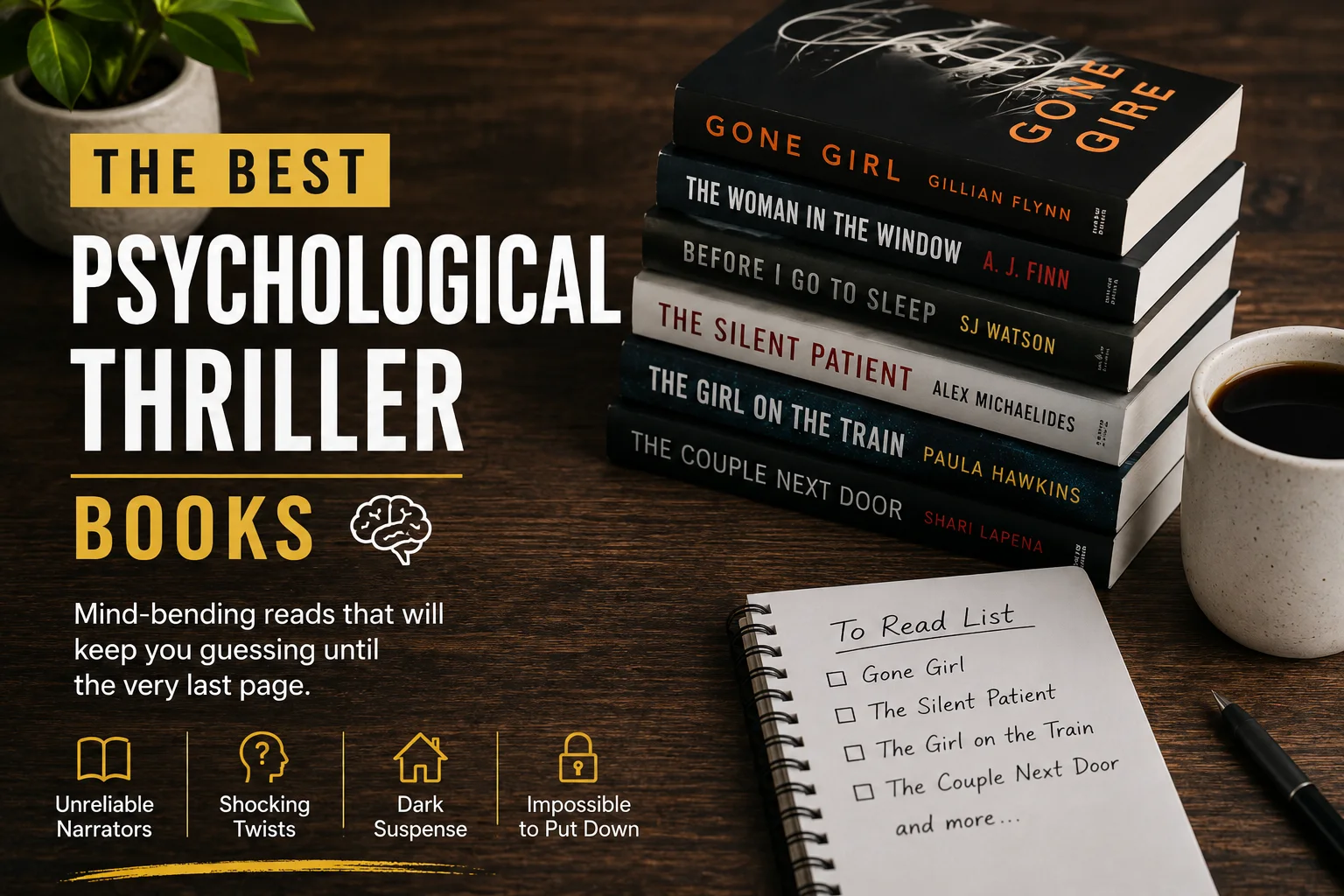
40 Best Psychological Thriller Books That Will Mess With Your Head (2026)

The best psychological thriller books don't just keep you up at night. They make you question what you thought was real for days afterward. You close the book and immediately flip back to chapter three because something in the final reveal changes everything you thought you understood about what happened on page 47. That specific feeling — half dread, half delight, entirely unable to put it down — is what separates a great psychological thriller from a good one. This list is built around that feeling. Every book here earns it. Some of them will unsettle you. A few will genuinely disturb you. All of them will make the next two weeks of commutes, lunches, and late nights significantly better. The list is organized by what you're in the mood for — because what you want from a psychological thriller changes. Some nights you want an unreliable narrator whose version of events unravels slowly. Other nights you want a plot twist that physically makes you put the book down and stare at the ceiling. We've sorted by that. Find your mood, start reading. Unreliable Narrator — You Never Know What's Real These are the psychological thriller books where the person telling the story turns out to be the least trustworthy person in it. The reader gets all the information through a narrator who is hiding something, misremembering, actively lying, or simply not mentally reliable. By the last chapter, you realize you've been reading a version of events that was shaped by someone with an agenda you only just understood. 1. Gone Girl — Gillian Flynn On the morning of Nick and Amy Dunne's fifth anniversary, Amy disappears. What follows is narrated alternately by Nick — who is suspicious, evasive, and not grieving quite right — and by Amy through her diary entries. The genius of Gone Girl is that Flynn trusts the reader to be unsettled by both narrators simultaneously. You don't know who is lying. You're not entirely sure either of them is telling the truth. The final third is genuinely startling in a way that is earned by the setup rather than dropped in from nowhere. One of the best psychological thriller novels of the last 20 years and still the benchmark for the unreliable narrator format. 2. The Woman in the Window — A.J. Finn Anna Fox is an agoraphobic psychologist who spends her days drinking wine, watching old films, and observing her neighbors through her window. One night she witnesses something she wasn't supposed to see. The problem: no one believes her. The book works because Finn makes Anna a genuinely sympathetic and genuinely unreliable narrator at the same time — you understand why people doubt her, and you doubt her yourself. The pacing is precise, the misdirection is fair, and the reveal lands. If you liked Gone Girl and haven't read this one, go immediately. 3. Behind Closed Doors — B.A. Paris Jack and Grace Angel appear to be the perfect couple. Their house is perfect. Their marriage looks perfect. Paris builds the dread of this novel through the gap between how things look from outside and what Grace knows is happening inside. It's told in alternating timelines — the present and the past — and the horror of it is that the reader understands what's happening long before the other characters do. Claustrophobic in exactly the right way. Not a comfortable read. Impossible to put down. 4. Before I Go to Sleep — S.J. Watson Christine wakes up every morning with no memory of her life. The man in her bed tells her he's her husband. The photos on the wall confirm it. But every morning she starts from zero, trusting only what she's told. Watson plays this setup with tremendous restraint — the horror of Christine's situation deepens slowly and the betrayal, when it arrives, is both surprising and in retrospect completely obvious. The psychological thriller premise here is as clean as it gets: what if you couldn't trust your own memory, and the person who filled in the gaps for you had a reason to lie? 5. The Silent Patient — Alex Michaelides Alicia Berenson shot her husband five times in the face and hasn't spoken a word since. Theo Faber, a criminal psychotherapist, becomes obsessed with understanding why. This debut novel sold over a million copies in its first year and the reason is simple: Michaelides constructs a puzzle with real precision. Every piece the reader is given feels complete. The reveal in the final pages recontextualizes the entire novel in a way that is genuinely jaw-dropping and — crucially — does not feel cheap. One of the best psychological thrillers published in the last decade. Start on a weekend, because you will not stop. 6. Verity — Colleen Hoover Struggling writer Lowen Ashby is hired to complete the remaining books in a bestselling series after the author, Verity Crawford, is incapacitated. While staying in the Crawford home, Lowen finds a manuscript — what appears to be Verity's autobiography — that contains confessions no one was ever meant to read. Hoover writes dark psychological suspense with the same emotional intensity she brings to her romance novels, and the combination is genuinely unsettling. The ending splits readers. That is its own kind of achievement. Disturbing in a way that lingers. Shocking Twists — The Ending Changes Everything The books in this section are built around a final revelation that reframes everything that came before it. The twist isn't a trick — it's the answer to a question the book has been asking from page one. The best ones make you want to immediately reread the first chapter with your new knowledge. They're all on this list because they earned it. 7. The Girl on the Train — Paula Hawkins Rachel takes the same commuter train every day and watches the same houses pass her window. She becomes fixated on a couple who seem to have the perfect life she's lost. Then, one morning, she sees something that shatters that image. Then the woman disappears. Hawkins tells the story through three women with incomplete, competing, and unreliable accounts of the same events. The structure is the point: each narrator knows something the others don't, and the reader assembles the truth from the overlapping gaps. A genuine phenomenon for good reason. 8. I Am Pilgrim — Terry Hayes A nameless American intelligence agent, known only as Pilgrim, is pulled out of retirement to investigate a threat that could kill millions. In parallel, a young Muslim man in Afghanistan has spent years perfecting a plan to destroy America. The two stories converge with a precision that is genuinely cinematic. At 700 pages, this should feel like a slog. It doesn't. It reads like a sprint. Hayes wrote this over a decade and it shows — the construction is meticulous. The best thriller debut in decades. The twist lands because it was built into the architecture from chapter one. 9. The Couple Next Door — Shari Lapena Anne and Marco Conti left their baby sleeping in the house while they attended a dinner party next door. They checked on her every 30 minutes. When they came home at midnight, she was gone. Lapena's debut novel works because the suspects are all people with plausible, understandable motives, and the revelations arrive in layers — each one seeming to close the case and then opening a new one. The pacing is relentless. The final twist is legitimately shocking. This is comfort food for psychological thriller readers in the best possible sense. 10. Big Little Lies — Liane Moriarty Told backward from a murder at a school trivia night to the events that led to it, Big Little Lies is simultaneously a sharply observed novel about friendship, motherhood, and domestic abuse, and a compulsively readable thriller. Moriarty tells you from page one that someone died at the trivia night. She withholds exactly who — and exactly what happened — for 400 pages, and the mystery of those two facts carries the entire book. The HBO adaptation is excellent. Read the book first. 11. The Kind Worth Killing — Peter Swanson On a flight from London to Boston, Ted Severson tells a stranger he'd like to kill his wife. She offers to help. Swanson then proceeds to completely subvert every expectation that premise creates. This is a novel that delights in misdirection and pulls it off because the misdirection is honest — all the information is there, the reader just doesn't see it coming. The body count is higher than expected. The ending is perfect. One of the best psychological thriller novels in recent years that doesn't get the attention it deserves. Domestic Suspense — Danger Inside the Home These psychological thriller books are set inside relationships, marriages, and families where the threat isn't a stranger but the person you share a house with. The domestic thriller subgenre has produced some of the most psychologically precise books in the category because it operates in the space everyone recognizes — home — and makes it strange and threatening. 12. Disclaimer — Renee Knight Documentary filmmaker Catherine Ravenscroft finds an anonymous novel on her bedside table — and realizes it tells a story she thought no one else knew. A story she's been hiding for twenty years. Knight builds the suspense through the gap between Catherine's outward composure and her inner terror, and through the slow revelation of what actually happened on a holiday in Italy decades earlier. The novel is told from two perspectives and the way those perspectives collide in the final act is genuinely brilliant. Underrated. 13. The Silent Wife — A.S.A. Harrison Jodi and Todd have been together for twenty years. Their life looks stable from outside: the condo, the routine, the unspoken arrangements that long-term couples build around themselves. Harrison opens the novel by telling the reader exactly what is going to happen. Then she proceeds to explain, with tremendous psychological precision, exactly how they got there. This is a character study as much as a thriller — the horror comes from understanding both people too well. Published just before Harrison died, it became a word-of-mouth bestseller because readers couldn't stop pressing it on other people. 14. Then She Was Gone — Lisa Jewell Ellie Mack disappeared at fifteen, ten years ago. Her mother Laurel has never recovered. Then Laurel meets a man in a coffee shop and falls into a new relationship — and discovers that his young daughter looks uncannily like the daughter she lost. Jewell's domestic thrillers are the best in the genre because she writes with genuine emotional depth rather than just plot mechanics. The reader cares about the characters, which makes the revelations hit harder than they would in a purely mechanical thriller. Read this one and then read all of Jewell's other books. 15. The Whisper Man — Alex North A single father moves to a new town with his young son to rebuild after a family tragedy. In this same town, years earlier, a serial killer the police call The Whisper Man abducted and killed several young boys. Now children are going missing again. North weaves a grief novel and a thriller into a single piece in a way that shouldn't work and absolutely does. The relationship between the father and son is as emotionally real as anything in literary fiction. The thriller plot is as tight as anything in genre fiction. One of the best psychological thriller novels of the last five years. Dark and Disturbing — Not for the Faint-Hearted These books are further into the dark than most psychological thrillers go. They deal with violence, obsession, and the psychology of people who do terrible things, written with enough craft that reading them feels purposeful rather than gratuitous. They're not comfortable. They're not supposed to be. They're also unforgettable. 16. Sharp Objects — Gillian Flynn Reporter Camille Preaker returns to her hometown in Missouri to cover the murders of two young girls. She has a complicated history with her mother, a troubled past she's written on her own skin, and a relationship with alcohol that is neither hidden nor resolved. Flynn's debut is darker and more personal than Gone Girl. It's also, in some ways, more disturbing — because the psychological horror here is rooted in family dynamics that feel uncomfortably real. Not easy. Absolutely essential reading for anyone who wants to understand what Flynn can do at full intensity. 17. You — Caroline Kepnes Joe Goldberg is a bookstore manager who falls in love with a customer named Guinevere Beck. The entire novel is told in second person — "you" — from Joe's perspective, as he proceeds to stalk, manipulate, and ultimately destroy everything in Beck's life while believing, genuinely and completely, that he is doing it out of love. Kepnes's achievement is making Joe's interior logic comprehensible without making it sympathetic. You understand exactly how he thinks. You find him monstrous. The two things coexist. This is one of the most formally daring psychological thriller novels published in the last decade. 18. The Push — Ashley Audrain Blythe Connor wanted nothing more than to be the perfect mother — the opposite of the cold, absent women in her family history. Then her daughter is born, and something feels wrong. Not with the baby's health. With the baby herself. Audrain's debut novel went to auction in fourteen countries before publication because it touches something real about postpartum anxiety, maternal ambivalence, and the horror of being the only person who sees something that no one else will acknowledge. It will make some readers deeply uncomfortable. That discomfort is the point. 19. All the Missing Girls — Megan Miranda Nicolette Farrell returns to her hometown to help sell her childhood home ten years after her best friend disappeared. Then another girl goes missing. Miranda tells this novel backward — from day 15 to day 1 — which means the reader knows the outcome from the opening and must figure out how it arrived there. This structural choice sounds like a gimmick and turns out to be essential: the form is the psychology. Understanding what happened requires understanding the past, and Miranda uses the reverse timeline to peel back layers in exactly the right sequence. Genuinely clever. 20. Luckiest Girl Alive — Jessica Knoll Ani FaNelli has built the perfect life — the right job, the right fiancé, the right apartment in Manhattan. She also survived something terrible at fourteen that she has never spoken about and has spent her entire adult life running from. Knoll writes Ani's voice with a precision that is sometimes almost painful: the performance of perfection over the reality of trauma. This is a psychological thriller that is equally a study of how women build armor and what happens when it cracks. Difficult in places. Very good. Slow Burn — Dread That Builds Over 300 Pages These psychological thriller novels don't open with a bang. They open with something small — an odd look, a wrong turn, a detail that doesn't fit — and they build from there, adding pressure so gradually that by the midpoint you're reading with your chest tight without being able to identify exactly when that happened. 21. The Kind Worth Saving — Peter Swanson The follow-up to The Kind Worth Killing. Malcolm Kershaw hires private detective Lily Kintner to find out if his wife is having an affair. The investigation leads to a murder that happened years earlier — and to a connection neither Malcolm nor Lily anticipated. Swanson builds his thrillers through accumulation: small revelations that reroute the narrative, each one arriving precisely when the previous revelation has settled into something that feels stable. The slow burn here is the gradual understanding that the situation is far more dangerous than it initially appeared. 22. The Secret History — Donna Tartt Richard Papen transfers to a small Vermont college and falls in with a tight group of classics students. Tartt opens the novel by telling the reader that the group committed a murder. The entire book is the explanation of how and why. This is a psychological thriller written at the pace of literary fiction: character first, plot second, atmosphere always — and it works precisely because Tartt makes the reader understand the internal logic of a group of brilliant, careless, morally unmoored people well enough to see the murder coming and still be shaken when it arrives. One of the great American novels of the past 30 years. Also a great thriller. 23. The Maid — Nita Prose Molly the Maid works at the Regency Grand Hotel, where she finds comfort in the orderly world of her work. When she discovers a guest dead in one of the rooms, she becomes the prime suspect. Prose builds her thriller through Molly's unique perspective — a character who reads social situations differently from most people and who therefore sees and misses things in unexpected ways. The slow burn here is the reader's growing understanding of what Molly can't see about the danger she's in. Gentle by thriller standards. Genuinely suspenseful by any standard. 24. Watch Me Disappear — Janelle Brown Billie Flanagan went missing on a solo hike a year ago. Her husband Jonathan and their teenage daughter Olive are beginning to reconstruct their lives when Olive starts having visions of her mother — visions that suggest Billie didn't die on that hike. Brown builds the dread through the gap between what the family believes and what the reader increasingly suspects. The slow accumulation of evidence here is rewarding precisely because Brown doesn't rush it — the novel earns its revelations. Series — When One Book Isn't Enough Some psychological thriller writers build their best work across multiple books. These series give readers the sustained payoff of characters who develop over time, relationships that shift and complicate, and an author's ability to hide information and reveal it across hundreds of pages across multiple volumes. 25. The Thursday Murder Club — Richard Osman (series) Four retirees in a peaceful English retirement village meet every Thursday to review cold cases from local police files. Then a real murder lands at their door. Osman's series is the rare psychological thriller that is also genuinely funny — the characters are vivid, the wit is sharp, and the plotting is precise underneath the warmth. The first book was the bestselling debut novel in UK publishing history. There are now four books in the series. Start at the beginning. Each one is better than the last. 26. Milkman — Anna Burns (standalone, but read everything she writes) This Booker Prize winner is a psychological thriller in the sense that the entire novel operates under conditions of surveillance, implied threat, and psychological manipulation — set in an unnamed city during an unnamed conflict that is unmistakably Northern Ireland's Troubles. The narrator is an eighteen-year-old woman being stalked by a powerful paramilitary figure. The prose is unlike anything else in contemporary fiction: indirect, circling, hypnotic. The dread is total. Not a conventional thriller by any measure. One of the most important novels of the last decade. 27. The Tattooist of Auschwitz — Heather Morris Based on the true story of Lale Sokolov, a Jewish prisoner who tattooed the identification numbers of fellow prisoners at Auschwitz, and the love story that emerged in the most impossible conditions imaginable. This isn't a conventional psychological thriller — it's historical fiction built on the sustained psychological tension of survival under a totalitarian system where death is arbitrary and constant. The thriller element is the question of whether these two people survive. Morris tells it with restraint and without sentimentality. Read it in one sitting, which you will. Three Books That Don't Fit a Category But Belong on Every List 28. Shutter Island — Dennis Lehane US Marshal Teddy Daniels arrives at Ashecliffe Hospital for the criminally insane to investigate a missing patient. Lehane builds the unreality of the island, the weather, and the institution so precisely that by the midpoint the reader genuinely cannot tell what's real. Unlike many psychological thrillers that use unreliable narration as a trick, Lehane uses it as a meditation on grief and self-deception. The twist is not the point. The understanding that arrives with the twist is. This is one of the best psychological thriller novels ever written and is still more frightening than the Scorsese film. 29. An Inspector Calls — J.B. Priestley A prosperous Edwardian family is celebrating their daughter's engagement when a police inspector arrives to investigate a young woman's suicide. He questions each family member in turn. Priestley's play (widely available as an ebook and stage text) is 80 pages and contains more genuine psychological thriller construction than most 400-page novels in the genre. Each revelation dismantles the previous comfortable account. No one in the Birling family is innocent. The inspector may not be who he says he is. Written in 1945, it still works perfectly. 30. Mexican Gothic — Silvia Moreno-Garcia 1950s Mexico. Socialite Noemí Taboada travels to a remote manor in the mountains to check on her cousin, who sent a disturbing letter suggesting her new husband's family is dangerous. Moreno-Garcia writes a psychological thriller that exists at the intersection of gothic horror and social critique — the Doyle family's house is physically wrong, their history is buried in violence, and the atmosphere of dread is maintained with absolute precision for 300 pages. The psychological thriller here is about colonialism and its psychological residue as much as it is about the supernatural. A genuinely original piece of genre fiction. How to Choose Your Next Psychological Thriller If you've never read a psychological thriller, start with The Silent Patient. It's the single best entry point to the genre: short, propulsive, and fair in its construction. The twist will ruin you for most other thrillers for at least three days. If you've read all the obvious ones and want something less discussed, read The Kind Worth Killing, Disclaimer, or All the Missing Girls. These are books that get recommended less frequently because they arrived in the shadow of bigger releases but are as good as anything on the list. If you want the dark end of the genre, read Sharp Objects before Gone Girl. Flynn at her most unguarded is more disturbing than Flynn at her most constructed, and Sharp Objects is the book she wrote before she knew she was writing for a large audience. It shows, in the best way. If you want something to give a reader who doesn't usually read thrillers, give them Big Little Lies or The Thursday Murder Club. Both are books that people who don't think they like thrillers end up loving, because they're primarily about people, and the thriller structure is what happens to those people. What all of the best psychological thriller books share is a commitment to the reader's intelligence. The twist works because the clues were real. The unreliable narrator works because the unreliability was built from the first page. The dread works because it was earned through character and situation rather than manufactured through shock alone. The books on this list earn what they deliver. That's the only criterion that matters. Frequently Asked Questions What makes a book a psychological thriller? A psychological thriller generates suspense primarily through the inner lives of its characters: unreliable narration, psychological manipulation, obsession, paranoia, or the gradual revelation of a character's hidden history — rather than through action, physical danger, or external threats alone. The tension in a psychological thriller is almost always the gap between what a character believes and what the reader suspects is true. The best ones collapse that gap in a final act that reframes everything that came before. What is the difference between a thriller and a psychological thriller? A conventional thriller generates tension through external danger: a chase, a countdown, a physical threat. A psychological thriller generates tension through internal or interpersonal danger: a marriage built on secrets, a narrator who can't be trusted, a manipulation the reader can see and the character can't. Many books blend both. The purest psychological thrillers could be set in a single room and remain just as frightening, because the threat comes from minds, not circumstances. Which psychological thriller has the best twist? Readers consistently cite The Silent Patient by Alex Michaelides as the psychological thriller with the most satisfying twist — one that genuinely reframes the entire novel in retrospect without feeling unfair. Gone Girl by Gillian Flynn is close behind. Shutter Island by Dennis Lehane is the most emotionally complex. The right answer depends on whether you want a twist that surprises you, a twist that disturbs you, or a twist that makes you immediately want to reread the book. All three of these deliver something different. Are psychological thrillers available on Kindle Unlimited? Many psychological thriller novels are available on Kindle Unlimited, particularly from indie authors in the genre. Traditionally published titles like Gone Girl and The Silent Patient are typically available only for purchase rather than through Kindle Unlimited, as major publishers generally don't enroll in KDP Select. However, the thriller category in Kindle Unlimited has a substantial catalog of quality independent authors writing psychological thrillers, many of whom are producing work that competes directly with traditionally published titles in the genre. Looking for more book recommendations? KindleBookHub curates genre-specific reading lists and ebook deals for thriller, romance, mystery, and sci-fi readers. Browse the latest recommendations →

Boost Your Book Sales: Expert Promotion Tips from Publicist Tany Soussana by Tany Soussana - Blog featured image
Blog

Boost Your Book Sales: Expert Promotion Tips from Publicist Tany Soussana

We're excited to share a guest post by Tany Soussana, a veteran literary and entertainment publicist. In this insightful piece, Tany shares invaluable tips on promoting your book effectively to ensure it reaches its full potential. Congratulations are in order if you are an author who has made it this far—getting your book published. Be it independently or traditionally (where the landscape has changed). Your glorious book was certainly no easy milestone to accomplish. Upon reaching your published fait accompli, I trust a sigh of relief, plus a good pat on the back, were not too far behind. What could be sweeter? We’ll get to that in just a bit. Much like the arduous process of writing your manuscript, the path to publication was far from simple. Yet, you made it and here you are on the flip side of being published. Remember how you felt when that day finally came and your manuscript turned into its current book form? Yes, a real book—by your making! The exhilaration you must have felt when you first saw and held an actual printed copy of your book as if it was a newborn baby. Following your first published day of reckoning, you most likely shared the wonderful news with your family, friends, co-workers, and anyone else you could possibly think of. After all, this was a big deal in your life. Becoming a published author. Publishing Nirvana Further considering the labor pains it took to even deliver your first published body of work; perhaps for some of you, this felt more like giving birth to triplets. Sound familiar? If this semblance of a flashback to publishing nirvana is hitting home for you, then do not pass—go! As in, go on to the next part of the work that awaits your book, which is getting it noticed if sales mean anything to you. As you have no doubt discovered by now, your book journey hasn’t stopped there, with just getting it published, but has started a whole new chapter that perhaps you weren’t prepared for or better equipped for. Yes, you now have to feed your book baby for it to grow and prosper. Think of growth as building momentum for your book to be publicly embraced by your future readers. In the publishing world, that means the big buzz word, “exposure,” for breathing life into your ultimate sales (what we all want). Welcome to the true business of publishing, where it now comes down to promotion, getting the word out, and drawing attention for selling your book. Generating Buzz This next vital step along your book’s lifespan will help to increase visibility and attract new readers. That’s right, straight-out promotion. Love it or hate it, it’s a must for achieving sales. Effective promotion is indispensable in generating buzz around your book, increasing sales, and reaching a broader audience. This process involves careful planning, producing engaging content, and utilizing various marketing strategies to leverage your book’s platform and reach a wider audience. Your success as an author is contingent on how you will maximize your promotional efforts to extend your book’s reach—where the greater the audience, the greater the sales. Think of promotion as mighty fuel for driving book sales. Your book’s gas. It’s up to you now as to how far you want to take your book ride. The power of promotion is an invaluable tool. It helps to increase visibility while generating interest in your book. Whereas, building awareness propels sales. This involves reaching out to target audiences, permeating the public consciousness, through various marketing strategies. If you are an author who is looking to make a difference between where your book is at now (perhaps just puttering along), or where it can be—with promotional reinforcement (best-laid plans), to support its growth and ultimate sales, then let me ask you this: If not now, when? Just like the jubilation of sharing your book's release with loved ones, bear in mind that as a proud author it is now up to you to keep your book baby alive, which brings us back to addressing this big question: How are you promoting your book? This is particularly key during the launch phase when your book is making its entry into the market. Promotion, particularly through PR (Public Relations), plays a pivotal role in a book’s success. Don’t Go It Alone So what do these promotional tactics look like? To help boost your sales activity, considering the value of PR will help to pave that course forward for you. Working together with a PR representative (aka, publicist) for their expert guidance through this process will benefit your book. In other words, don’t go down this uncharted path alone; especially for author newbies who may be less familiar with how the promotional terrain works. The sustenance of your book depends on it, where bringing in PR support will help to increase your book’s exposure through media, such as print articles and electronic interviews (television, radio, podcasts). Your promotional playing field should further encompass these smart marketing elements (to reinforce your media coverage), such as advertising, social media, blogs, and viral content. These facets collaborate to formulate a comprehensive marketing platform from which to grow your book’s profile, into “high-profile,” and increase your sales effectiveness. If you aspire to secure media for your book with features in print, radio, and television, then PR is the optimal route by which to achieve these objectives. A publicist can assist you in navigating the media trenches and forging connections to effectively promote your book. PR serves as a fundamental instrument in establishing a platform for your book, while complementing other marketing endeavors as well. The realm of marketing your book can be intricate and multifaceted. There are numerous considerations to contemplate when determining how to best promote your book and devise a “positioning” strategy that serves you. The reassuring fact is that there exists a myriad of marketing avenues at your disposal, each offering its distinct advantages. Your Book’s New BFF To gain public recognition for both your book and yourself as an author, particularly through media exposure, it's important to acquaint yourself with the power of PR as facilitated through a publicist—and potentially your book’s new BFF. Whether it pertains to your current published book or forthcoming works, a publicist can prove to be a valuable ally in promoting your publications effectively. To ensure your success in today’s competitive book market, it is crucial to also consider that without the proper promotional support, your book may struggle to gain visibility and relevance, and eventually fade into obscurity. Considering the time and effort you have dedicated to writing your book, isn’t it worth weighing in what it will take for your book to reach its fullest potential in the public domain? Through a PR plan, facilitated through the professional support of a publicist, this will make the difference between where your book is now, perhaps thirsting for public attention, and where it should be. Imagine a comprehensive marketing strategy that serves your book’s platform. Having the expertise of a publicist in your corner can be beneficial as they will help to showcase your book's unique features, create a compelling marketing narrative, and introduce its value to the appropriate audience within your topical scope. Yes, they do all that heavy lifting for you. Exposure and Relevance Further considering, a publicist’s primary function is to establish a strong media foothold through an outreach plan that enhances the visibility of your book in relevant markets. Through media placements, interviews, reviews, and other promotional activities, your publicist can generate excitement around your book, significantly increasing public awareness as helping to drive book sales. If your book is about to be published and you are counting down within that timely window to when it will be fresh off the presses, this is the most crucial period to start on its promotion—think pre-sales—as best facilitated through a publicist. Their role will be instrumental in leveraging your book’s most competitive edge and delivering it to the appropriate book trade and consumer sectors; where “buzz” starts to take off and the longevity of your book depends on it. Having an effective media strategy in place through this professional guidance will help to influence groundswell exposure among the broadest audience. What We All Want Plain and simple, the key to effective promotion lies in creating and sustaining public interest in your book. Your springboard to maximizing awareness vis-à-vis media opportunities will help to maintain public intrigue, as amplifying your book’s impact and securing long-term success in the publishing arena. It is imperative to further understand that without skilled promotion backing the launch of your book, it may just go unnoticed and undiscovered. Imagine a book languishing in a drawer, receiving no attention or traction. Don’t let “yours” go there! This lack of activity can be detrimental to a book's success as it takes nothing short of promotion, as best supported through media coverage, to boost book sales. Also consider, for those of you with regular jobs (until your book takes off), while you are toiling at work, how many hours and how many days are passing by as your beautiful published book possibly just sits there, going unnoticed—clicking its heels three times hoping to get lucky? Bestseller Slice of the Rainbow In no short order, you must take proactive steps. If you want your book to stand out and make a lasting impression, utilizing the power of publicity (media exposure) will play a key role in generating the needed buzz for your book; bringing us back to sales and what we all want. Remember, the road ahead for authors is all the same for reaching that bestseller slice of the rainbow. When that is, and how that is, only time will tell. The publicity course is a different experience for every author. So do your author-self a favor by not overlooking that needed detail in your book’s journey, at least by publishing standards—and that is the promotional value of PR. Your book will depend on this critical role and contribution to its livelihood. Let’s also not forget, getting your book released was only the first step of many yet to be taken; before your book can claim its place and actually start to create traction on a wider scale. If Not Now, When? If you are an author with a newly released book, or soon-to-be-released, start creating movement on your book now. Get your publicity strategy in place to help not only create awareness about your book, but as importantly, to increase it. Set your sights on that proactive endgame. For those of you who may have ventured into DIY promotional activities (without the professional support of a publicist), then you probably also realized how truly tough it is in the marketing and media trenches; particularly for newbie authors, let alone the seasoned ones. Your book should be enjoying its rightful place in the marketplace. Don’t you think? Why spend your precious time and energy writing and publishing a book (going through that whole exercise possibly years in the making), if you don’t really have a marketing plan or any idea for promoting it properly to ensure its ultimate success? This should be part of every author’s agenda upon completing their book. Creating exposure! Especially advance exposure (pre-publication). Just think of all those pre-sales. Your Market is Waiting Do your promotion right and let expert advice help to get you there for meeting your book’s objectives. Are you ready to take the PR plunge? By now you must have drawn your own conclusions about what it’s going to take to move your book needle UP. The mighty promotional push is indeed a process, and not an easy one, best not attempted alone. PR support will make a difference from leveraging your public presence, to effectively saturating the competitive book world. The place where you want to be found. Start to enjoy the value of the media spotlight beaming on your prized book and you as its author. If not now, when? With a proactive marketing strategy in high gear, people will be made aware of your book’s availability along with all the fanfare to embrace it. Interested in promoting your book? Contact us for more information. Tany Soussana is a veteran literary and entertainment publicist whose roots in PR stem from her tenure at the prestigious firm, Rogers & Cowan. She went from working in the company’s Motion Picture Group and Personalities Unit, to running the Literary Division—responsible for its start-up as a result of her unprecedented, successful campaign for the diet mega-bestseller and fitness phenomenon, The Zone. A whole new boom in books started being enjoyed by the company, predominantly recognized for its clout in entertainment. Upon leaving Rogers & Cowan, Soussana has since opened her Los Angeles-based PR company, The Soussana Group–TSGpr in tandem with her content marketing service, epiContent, where she has continued to represent a mix of clients in publishing and entertainment. Her combined literary/entertainment background has provided an added value to authors keen on the crossover potential of their books to the screen. In recent years, her service has also dove-tailed into ghostwriting—an organic progression that evolved when a PR author client asked her to pen their next book. Fast forward from that experience, Soussana currently has two published books as a ghostwriter with both already bestsellers. Thank you to Tany Soussana for these fantastic insights. If you're interested in learning more about book promotion or need assistance, feel free to reach out to her at The Soussana Group–TSGpr. Stay tuned for more expert advice on Kindle Book Hub!